.avif)


.png)
You've done everything right.
Your website traffic is climbing. Your LinkedIn posts get engagement. People know your product exists.
But your pipeline looks thin. Your sales team keeps asking where the qualified leads are. And your CAC keeps creeping up while your conversion rates stay flat.
Here's what's happening: You're generating awareness, but you're not converting it into revenue.
This gap costs SaaS companies an estimated $1 trillion annually in the United States alone. The problem isn't that your marketing doesn't work. The problem is that awareness without a conversion strategy is just expensive noise.
This guide shows you how to bridge that gap with a practical, step-by-step approach to turning awareness into actual revenue.
Why Awareness Doesn't Equal Revenue
Most SaaS teams treat awareness and conversion as separate problems.
Marketing generates leads. Sales closes deals. Sounds simple.
But here's the reality: 73% of marketing qualified leads never get contacted by sales teams. And even when they do, 79% of marketing leads never convert into sales.
The disconnect happens because awareness campaigns focus on reach while sales teams focus on close rates. Nobody owns the middle—the nurturing, qualification, and education that turns a curious visitor into a ready buyer.
The modern SaaS buyer doesn't want to talk to sales until they're 57% through their decision process. They're researching, comparing, and evaluating on their own terms.
If you're not guiding them through that journey, you're losing them to competitors who are.
Step 1: Map Your Buyer Journey (Not Your Sales Process)
Your sales process tells you what you want to happen. Your buyer journey tells you what actually happens.
Start by identifying the three stages your buyers move through:
Awareness Stage: They recognize a problem but don't know the solution yet. They're searching for educational content, frameworks, and understanding.
Consideration Stage: They're evaluating different approaches and solutions. They're comparing features, reading case studies, and looking for proof.
Decision Stage: They're ready to choose a vendor. They want demos, pricing, and reassurance that you can deliver.
💡 Quick Win: Interview your last five customers and ask them what content they consumed before booking a demo. You'll find patterns that reveal exactly what your buyers need at each stage.
Create Stage-Specific Content
Each stage requires different content:
Awareness: Blog posts, guides, frameworks, industry reports
Consideration: Case studies, comparison pages, webinars, product tours
Decision: ROI calculators, implementation guides, customer testimonials, pricing transparency
Most SaaS companies create plenty of awareness content but almost no consideration or decision content. That's where the revenue leak happens.
Step 2: Build a Lead Nurturing System That Actually Works
Lead nurturing isn't about sending weekly newsletters.
It's about delivering the right information at the right time to move buyers forward.
Companies that excel at lead nurturing generate 50% more sales-ready leads at 33% lower cost. The difference is strategic engagement over time.
Set Up Behavior-Based Nurture Tracks
Create email sequences triggered by specific actions:
Downloaded a guide? Send them a case study showing how another company implemented the concepts.
Visited your pricing page? Send them an ROI calculator and a comparison guide.
Attended a webinar? Follow up with the recording, slides, and a personalized invitation to book a demo.
Leads nurtured through multiple channels convert 20% more often than single-channel nurturing. Use email, retargeting ads, LinkedIn messages, and personalized landing pages together.
Personalize Based on Buyer Stage and Industry
Generic nurture emails get ignored. Personalized emails achieve 29% open rates and 41% click-through rates.
Segment your nurture tracks by:
Industry (healthcare SaaS buyers have different concerns than fintech buyers)
Company size (enterprise needs differ from startup needs)
Buyer stage (awareness vs. decision-ready)
Behavior patterns (engaged vs. dormant)
⚠️ Warning: Don't confuse personalization with complexity. Start with three segments maximum. Add more only after you've proven the first three work.
Step 3: Align Your Sales and Marketing Teams
Here's an uncomfortable truth: Companies with misaligned sales and marketing teams achieve 208% less revenue than organizations with connected functions.
The gap happens because marketing measures leads while sales measures closed deals. Nobody owns the conversion rate between the two.
Create a Shared Definition of a Qualified Lead
Marketing and sales need to agree on what makes a lead ready for sales outreach.
Define clear criteria:
Company fits your ideal customer profile
Contact has decision-making authority or influence
They've engaged with consideration-stage content
They've shown intent signals (pricing page visit, demo request, competitor comparison)
Document this in a service level agreement (SLA) between teams. Marketing commits to delivering X qualified leads per month. Sales commits to contacting them within Y hours.
Build a Lead Handoff Process
Most leads die in the handoff between marketing and sales.
Create a clear process:
Step 1: Marketing scores and qualifies the lead based on agreed criteria.
Step 2: Marketing alerts sales immediately when a lead hits qualification threshold.
Step 3: Sales contacts the lead within 24 hours with personalized outreach referencing their engagement history.
Step 4: Sales reports back on lead quality so marketing can refine targeting.
Companies that implement this closed-loop process see 32% year-over-year revenue growth on average.
Step 4: Optimize Your Conversion Funnel
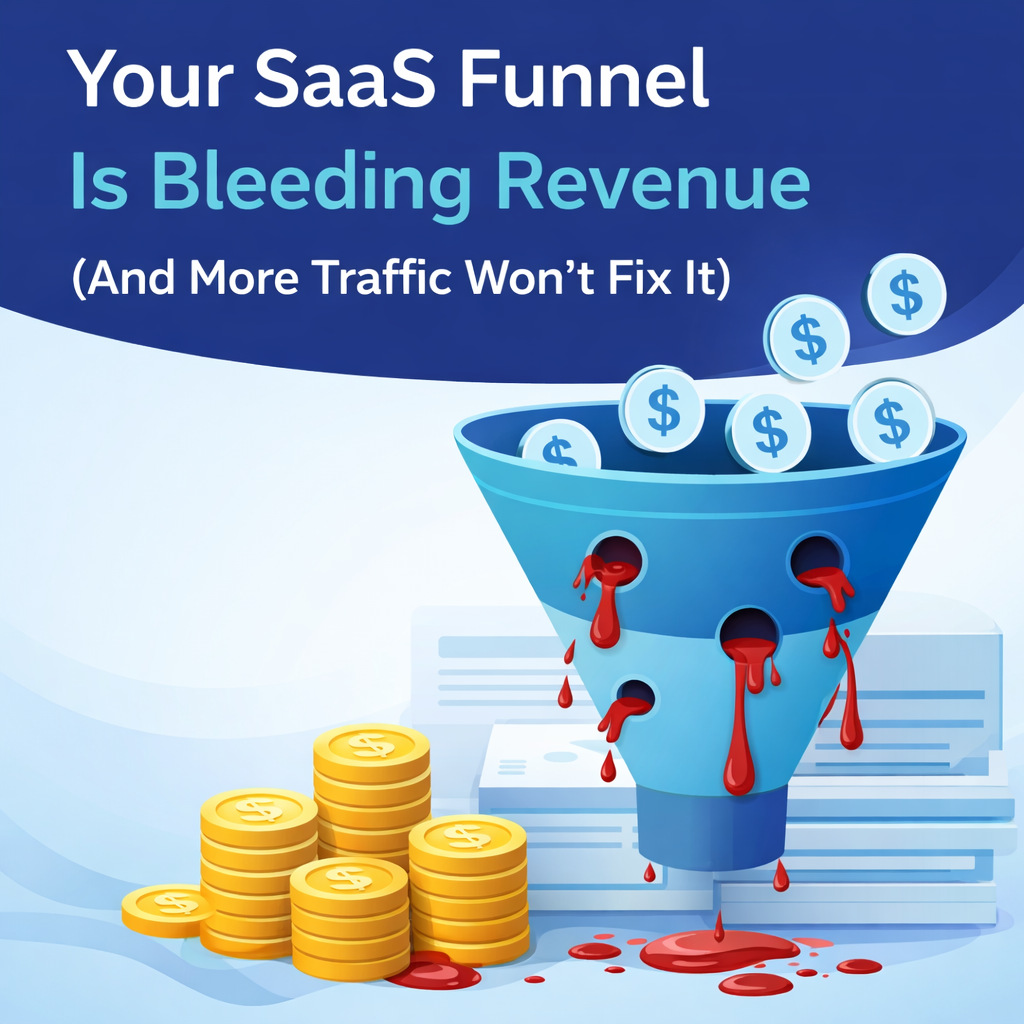
Your funnel has leaks. Every SaaS funnel does.
The question is whether you know where they are and how to fix them.
Identify Your Drop-Off Points
Track conversion rates at each stage:
Website visitor → Email subscriber
Email subscriber → MQL (Marketing Qualified Lead)
MQL → SQL (Sales Qualified Lead)
SQL → Opportunity
Opportunity → Customer
Where do you lose the most people? That's where you focus first.
If you're losing leads between MQL and SQL, your qualification criteria might be too loose. If you're losing them between opportunity and customer, your sales process or product positioning needs work.
Fix Your Biggest Leak First
Don't try to optimize everything at once.
Pick your worst-performing stage and run focused experiments:
Low website-to-subscriber conversion? Test different lead magnets, form placements, and value propositions.
Low MQL-to-SQL conversion? Improve your lead scoring model or add more consideration-stage content.
Low SQL-to-opportunity conversion? Train your sales team on better qualification questions or improve your demo process.
Measure results over 30 days, then move to the next leak.
Step 5: Measure What Actually Matters
Vanity metrics feel good but don't pay bills.
Stop obsessing over website traffic and social media engagement. Start tracking metrics that connect to revenue.
Track These Metrics Weekly
Customer Acquisition Cost (CAC): How much you spend to acquire each customer. The average for SaaS is $702, but you need to know your specific number.
CAC Payback Period: How long it takes to recover your acquisition cost. SaaS companies typically spend $1.18 to $1.50 to acquire every dollar of new ARR.
Lead-to-Customer Conversion Rate: What percentage of leads eventually become customers. This tells you if your nurturing and sales process work.
Sales Cycle Length: How long it takes from first contact to closed deal. Longer cycles mean higher CAC and slower growth.
Pipeline Velocity: How quickly deals move through your pipeline. This combines deal size, win rate, and sales cycle length into one metric.
Set Up a Revenue Attribution Model
You need to know which marketing activities actually drive revenue.
Use multi-touch attribution to track every touchpoint in the buyer journey. This shows you which content, campaigns, and channels contribute to closed deals.
Most marketing automation platforms include attribution reporting. If yours doesn't, use a spreadsheet to manually track the first touch, last touch, and key middle touches for each closed deal.
Review this data monthly and shift budget toward channels and content that drive actual revenue.
Step 6: Create Feedback Loops That Drive Improvement
The best SaaS companies don't just execute. They learn and adapt continuously.
Run Monthly Revenue Reviews
Bring marketing and sales together monthly to review:
Pipeline health and conversion rates
Lead quality and sales feedback
Content performance and buyer engagement
CAC trends and efficiency metrics
Use this meeting to identify problems early and test solutions quickly.
Interview Your Customers
Your customers know exactly what content helped them decide.
Within 30 days of closing a deal, interview new customers and ask:
What problem were you trying to solve?
What content did you find most helpful?
What almost stopped you from buying?
What convinced you we were the right choice?
These insights reveal exactly what your awareness content needs to communicate and what your nurture process needs to deliver.
Test, Learn, Iterate
Conversion optimization is ongoing.
Run one focused experiment per month:
Test a new lead magnet format
Try a different email sequence
Experiment with pricing page messaging
Adjust your lead scoring criteria
Measure results. Keep what works. Kill what doesn't. Repeat.
The Bottom Line
Awareness without conversion is just expensive brand building.
The SaaS companies that win are the ones that connect awareness to revenue through strategic nurturing, sales alignment, and relentless optimization.
You don't need more traffic. You need to convert the traffic you already have.
Start with one step from this guide. Map your buyer journey or build your first nurture sequence. Fix your biggest funnel leak or align your sales and marketing teams on lead definitions.
Pick one thing and execute it this week.
Revenue follows execution, not planning.
Ready to Convert Awareness Into Revenue?
If you're a SaaS company struggling to turn awareness into pipeline, we can help.
Veewz specializes in demand generation and GTM strategy that drives actual revenue for SaaS companies in healthcare, fintech, and technology.
We'll audit your current funnel, identify your biggest conversion gaps, and build a strategic plan to fix them.
Book a GTM strategy call and we'll walk through your specific challenges and show you exactly where you're losing revenue.
About the Author



.svg)
.svg)


.png)





.png)


.png)

.jpg)


.jpg)


