.avif)


You're over-tooling.
I see it every week. Founders with 15 tabs open, three CRMs they're "evaluating," and a Zapier account connecting tools they haven't touched in months.
The pressure makes sense. You look at companies at Series B and think you need their infrastructure to get your first 10 customers. You see other founders posting about their tech stacks on LinkedIn and wonder if you're falling behind.
You're not.
Here's what's actually happening: you're buying tools to avoid the uncomfortable work of talking to buyers. Every new software purchase feels productive. It feels like progress. But it's procrastination dressed up as preparation.
The data backs this up. Organizations waste 30% of their SaaS spending on unused subscriptions and redundant tools. Companies are managing an average of 220 applications, and most organizations only know about 40% of what's actually running in their environment.
You don't have a scaling problem yet. You have a validation problem.
Your job right now is to learn who buys, why they buy, and what makes them hesitate. Every tool you add should directly support that learning process. If it doesn't, you're just creating maintenance debt.
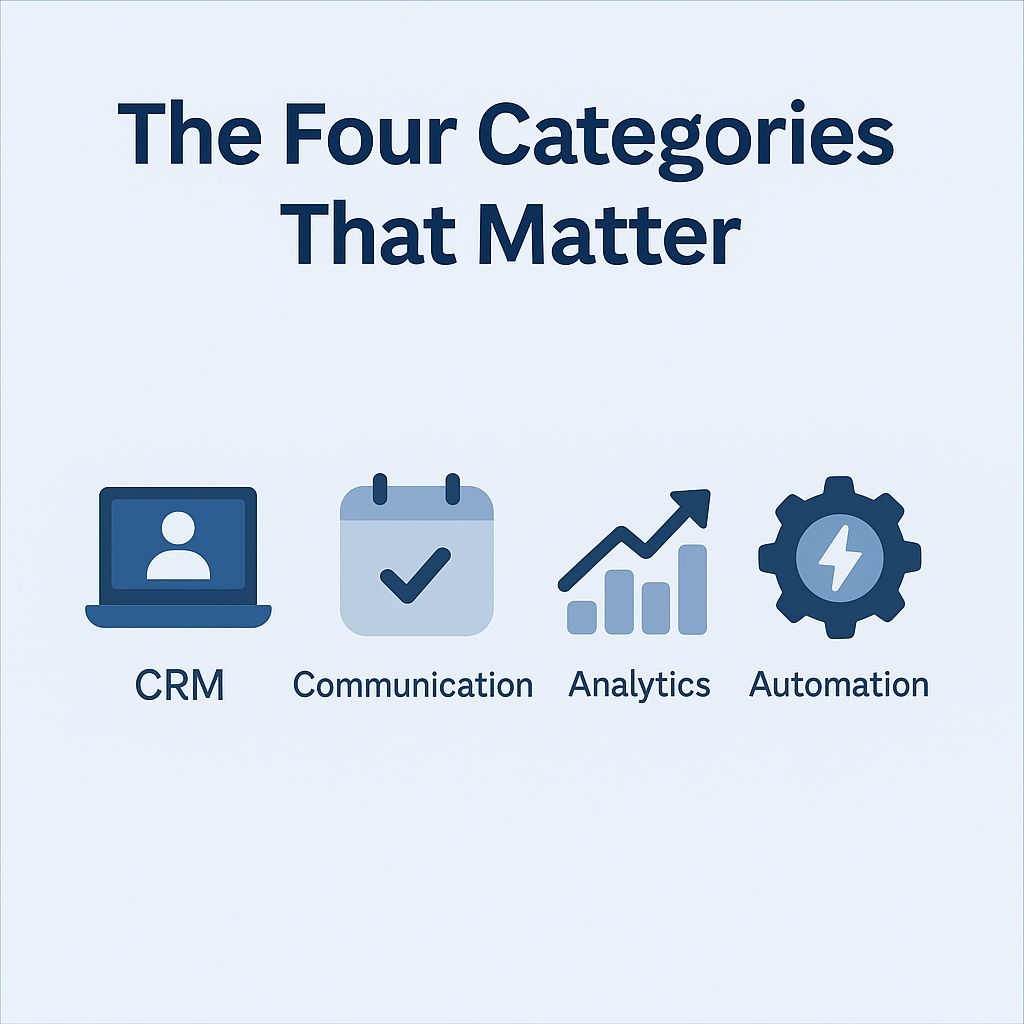
The Four Categories That Matter
Your early-stage sales stack needs exactly four categories of tools. Not 15. Not even 8.
Four.
1. CRM: Track Conversations, Not Pipelines
You need visibility on who you've talked to, what they said, and when to follow up.
That's it.
Start with HubSpot's free tier or Pipedrive. Both give you the basics: contact management, deal tracking, and follow-up reminders. You don't need enterprise features. You don't need advanced pipeline stages. You're having 20 real conversations, not managing 200 leads.
The goal here is simple: never lose track of a conversation. When someone says "circle back in two weeks," you need a system that reminds you. When you notice three prospects asking about the same feature, you need to see that pattern.
Your CRM should take 5 minutes to update after each call. If it takes longer, you're using the wrong tool or tracking the wrong data.
2. Communication: Remove Friction From Conversations
Here's your communication stack:
Loom for async demos and product walkthroughs. When a prospect asks "can you show me how this works," you record once and send the link. This saves you from scheduling 30-minute calls for 5-minute questions.
Calendly (or any meeting scheduler) to eliminate email tennis. The back-and-forth of "Does Tuesday work?" "Actually, can we do Wednesday?" kills momentum. Let them pick a time from your available slots.
Your actual email client. You don't need a separate outreach platform. You need to write good emails and follow up consistently. The tool you already have works fine.
Research shows that leads who speak with a sales representative are 70% more likely to become paying customers. Your communication tools should make it easier to have those conversations, not replace them.
3. Analytics: Track Behavior, Not Vanity Metrics
Google Analytics plus Mixpanel's free tier gives you what you need to understand user behavior.
You're looking for three things:
• Activation: Are people completing setup or first use?
• Engagement: What features do they actually touch?
• Drop-off: Where do they stop using your product?
Page views don't matter. Time on site doesn't matter. What matters is whether people who sign up actually use your product, and whether usage predicts conversion.
If you're pre-product or still in beta, you might not need analytics tools yet. Spreadsheets tracking who you talked to and what they said might be enough. Don't add complexity before you need it.
4. Automation: Connect the Basics
Zapier handles your basic workflow automation. Connect your CRM to your email. Trigger follow-up reminders. Log meetings automatically.
The key word is "basic." You're not building complex nurture sequences. You're not setting up multi-touch attribution. You're connecting two or three tools so information flows between them without manual data entry.
Each time you add a new integration, ask: does this save me at least 30 minutes per week? If not, the maintenance cost outweighs the benefit.
What You Don't Need Yet
Here's what you can skip until you're consistently closing deals:
Marketing automation platforms. You're not running campaigns to thousands of leads. You're having individual conversations with dozens of prospects. Email automation can wait.
Advanced attribution tools. You don't have enough data points to make attribution meaningful. You know exactly where your leads came from because you're personally involved in every conversation.
Sales intelligence databases. Tools like ZoomInfo and Clearbit are powerful, but you're not doing high-volume outbound yet. LinkedIn and basic research give you what you need for 10-20 targeted conversations.
Conversation intelligence AI. Recording and analyzing sales calls makes sense when you're training a team. Right now, you're the only person on calls. You know what happened.
Save your budget. More importantly, save your time.
The Integration Trap
Every new tool creates maintenance debt.
You need to learn the interface. Configure the settings. Connect it to your other tools. Train anyone else who touches it. Update documentation. Troubleshoot when something breaks.
One founder told me: "Each time you make a shift, it can have cascading effects from actual actionable work down to the documentation you built six weeks ago being unreflective of your process."
This is the hidden cost nobody talks about. The tool might only cost $50 per month, but you're spending 3 hours a week managing it. That's $50 in software plus hundreds in opportunity cost.
Before adding any tool, ask yourself: Does this directly help me close deals?
If the answer is "it might help later" or "everyone else uses it," skip it.
What Actually Drives Early Sales
Every successful startup has the same story. Their first 10, 50, even 100 customers came from founders who did the unglamorous work of direct outreach, cold calling, and personal selling.
Your competitors aren't winning because they have better tools. They're winning because they talk to more customers.
Research on early-stage SaaS companies found that founders who followed one rule succeeded faster: they didn't build anything that wasn't directly requested by customers. This approach proved invaluable for understanding real buyer needs.
The same principle applies to your sales stack. Don't buy anything that isn't directly solving a problem you're experiencing right now.
B2B buyers will only buy if they see you as a trusted advisor. That trust comes from conversations, not from sophisticated automation. You build credibility by understanding their specific situation and offering relevant solutions.
Tools can't do that for you.
When to Add Complexity
You'll know it's time to expand your stack when you hit clear constraints:
You're losing track of conversations. If you're forgetting to follow up or can't remember what you discussed with a prospect, your CRM needs an upgrade.
Manual tasks are blocking revenue. When you're spending more time on administrative work than talking to buyers, automation makes sense.
You're hiring your first sales rep. New team members need systems to follow. This is when you invest in proper onboarding tools, call recording, and process documentation.
You've validated your sales process. Once you know what converts and can repeat it consistently, you can optimize and scale.
Many founders stall around $25,000 in monthly recurring revenue. The issue isn't usually their product or market. It's that they added complexity too early and lost focus on the fundamentals.
Build your foundation first. Add sophistication only when simplicity blocks growth.
The Minimalist Advantage
Companies are finally figuring this out. After years of tool sprawl, organizations are consolidating. They're trimming vendor lists and choosing platforms that offer integrated capabilities over specialized point solutions.
You have an advantage as an early-stage founder. You can start lean and stay lean.
Simple beats sophisticated when you're doing everything yourself. The best tool is the one you actually use. A basic CRM you check daily is better than an enterprise platform you log into once a week.
Your time is your scarcest resource. Spend it on buyer calls, not configuring Salesforce.
Your Action Plan
Here's what to do this week:
Audit your current stack. List every tool you're paying for. For each one, write down the last time you used it and what specific problem it solves.
Cancel the dead weight. If you haven't used a tool in two weeks, you don't need it. Cancel the subscription. You can always reactivate later if you were wrong.
Set up the four essentials. If you don't have a CRM, meeting scheduler, basic analytics, and simple automation in place, add them this week. Spend no more than 2 hours total on setup.
Schedule 5 customer conversations. This is the most important item. Your sales stack exists to support conversations, not replace them. Block time for actual buyer calls.
Create a decision filter. Before buying any new tool, write down the specific problem it solves and the metric that will prove it's working. If you can't articulate both, don't buy it.
The goal is to get back to what matters: understanding your buyers and helping them solve real problems.
Your sales stack should fade into the background. It should be so simple that you barely think about it. That's when you know you've got it right.
What's your current sales stack? Are you over-tooled or under-focused? If you're spending more time managing software than talking to customers, we should talk. Book a GTM call and we'll help you strip out the complexity and focus on what actually drives revenue.
About the Author




.svg)
.svg)


.png)













.png)


.png)

.jpg)


.jpg)


