
Blog / Article

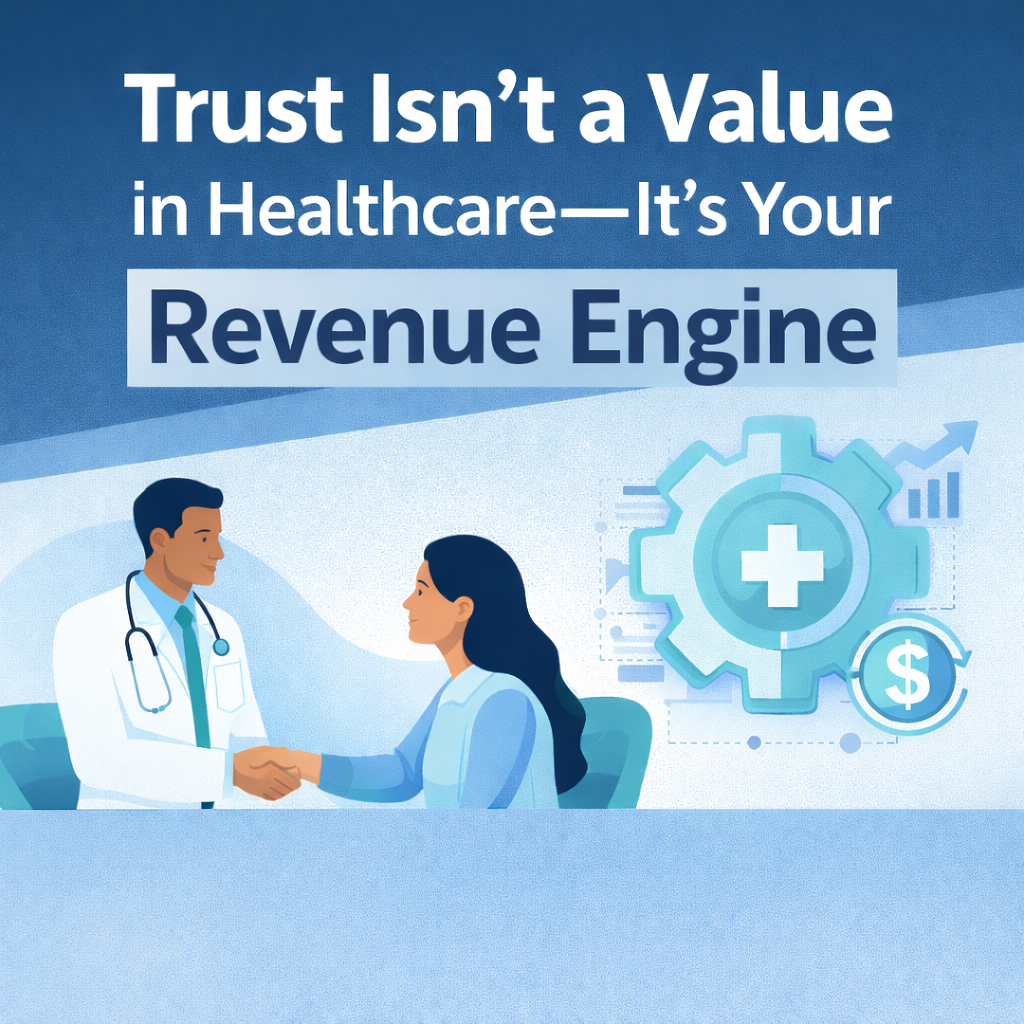
Trust Isn't a Value in Healthcare—It's Your Revenue Engine

Shan Serran
Shan Serran
January 21, 2026

You can't skip trust and jump straight to patient acquisition.

Most healthcare brands treat trust as a soft metric—something you build through good service and hope it translates into loyalty. But the data tells a different story. Trust isn't a nice-to-have in healthcare. It's the variable that determines whether your marketing converts or your budget disappears into traffic that never becomes revenue.

Here's what the numbers show: trust in individual doctors dropped from 93% in 2023 to 85% in 2025. Trust in the FDA fell from 65% to 53% in the same period. Two-thirds of patients say trust in healthcare has declined in the last two years, and the top reason is simple—patients believe the healthcare system acts out of self-interest rather than theirs.

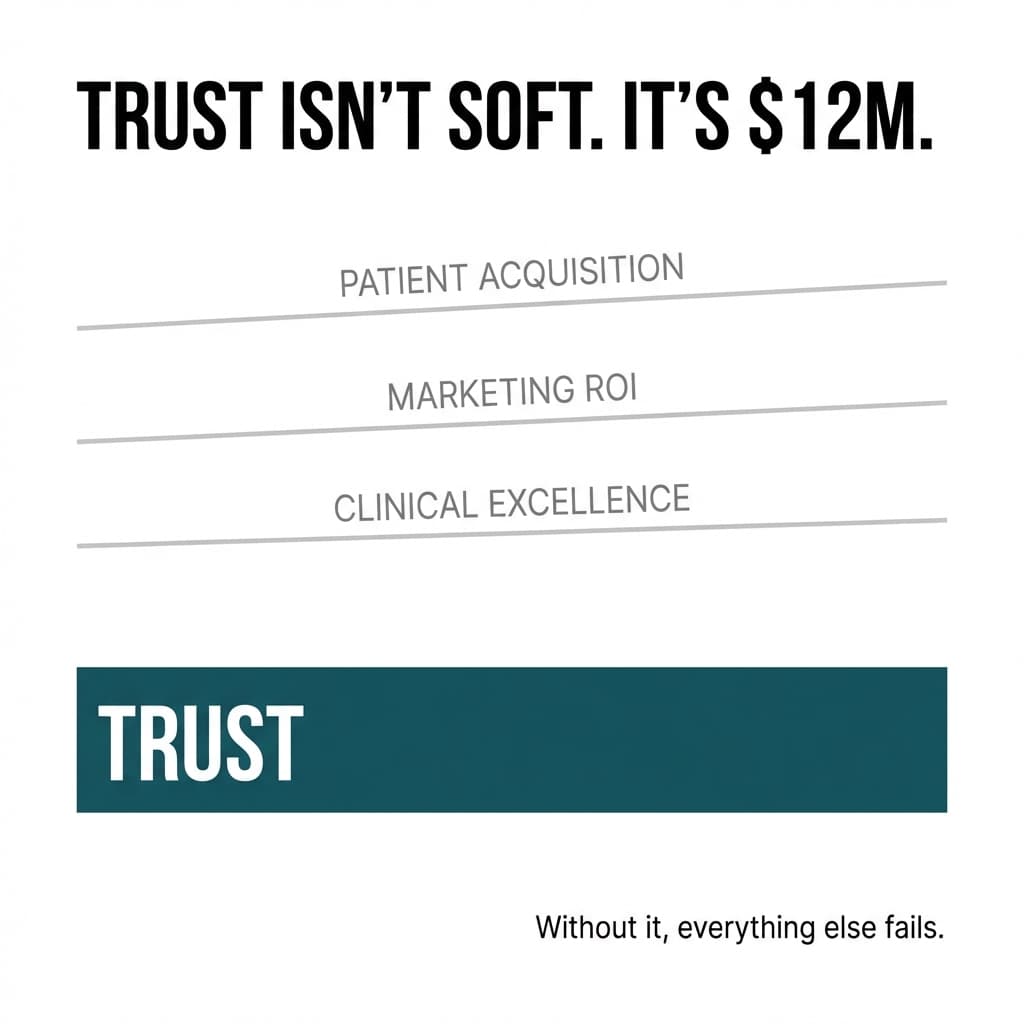
This isn't abstract. A one-point decline in trust scores can result in more than $12 million in annual lost revenue for a large health system. That's pipeline erosion at scale.
article cover

Trust Drives Decisions More Than Clinical Knowledge Does

You assume patients choose providers based on expertise or outcomes. They don't.

Research on rheumatoid arthritis patients found that patient trust in physicians had a substantially greater effect on confidence in treatment decisions than disease-specific knowledge, disease-related factors, or demographic characteristics. Trust wasn't one factor among many—it was the primary decision driver.

This matters because most healthcare marketing focuses on credentials, technology, and outcomes. Those things build credibility, but they don't close the gap between consideration and conversion. Trust does.

Patients who trust their providers are 2.6 times more likely to adhere to treatment plans and continue with the same provider. Trust directly impacts retention—the metric every healthcare brand should be tracking but most aren't.

Satisfaction Doesn't Lead to Loyalty—Trust Does

You can deliver excellent care and still lose patients.

A study of 1,696 patients found that patient satisfaction has no direct relationship with patient loyalty. But satisfaction leads to loyalty when patient trust acts as the mediating variable. You can't skip the trust layer and expect retention to hold.

This is where most healthcare brands break down. They optimize for satisfaction scores—shorter wait times, better facilities, responsive staff—but they don't build the infrastructure that signals trustworthiness. Patients leave satisfied but not committed.

The operational infrastructure matters as much as clinical competence. Patients say that timely care, respectful listening, and pricing transparency are the top three ways to rebuild trust in healthcare. Those aren't clinical variables—they're system variables.

Trust Is a Long-Term Investment That Compounds

You're under pressure to show short-term results. That pressure is expensive.

Healthcare brands that invest 60% of their budget in long-term brand-building achieve 2.5x greater customer lifetime value than those focused solely on short-term activation. McKinsey data confirms that in healthcare, trust isn't just a value—it's a prerequisite for sustainable growth.

Short-term tactics—paid ads, promotional offers, aggressive remarketing—can generate inquiries. But if those inquiries don't convert because trust hasn't been established, you're burning budget on awareness that doesn't stick.

Trust compounds. Every interaction, every transparent pricing conversation, every follow-up that happens when promised—these build the foundation that makes your next campaign more effective. Without that foundation, you're starting from zero every time.

How Healthcare Brands Build Trust at Scale

You can't manufacture trust through messaging alone. It shows up in systems.

Pricing transparency is one of the highest-impact trust signals you can deploy. Patients rank it as the third most important factor in rebuilding trust, behind timely care and respectful listening. If your pricing is opaque, you're signaling that you operate in your own interest—not theirs.

Consistency across touchpoints matters more than most brands realize. If your website promises one experience and your intake process delivers another, trust erodes immediately. Patients are pattern-matching for reliability, and every misalignment is evidence that you won't follow through.

Responsive communication isn't about speed—it's about predictability. Patients need to know when they'll hear from you and what happens next. Uncertainty breeds distrust. Clear timelines and follow-through build the opposite.

Educational content that doesn't sell establishes authority without extraction. When you explain a condition, a treatment option, or a process without pushing toward conversion, you signal that you're willing to inform before you ask for commitment. That's rare in healthcare, and patients notice.

Trust Is Measurable—And You Should Be Tracking It

You can't improve what you don't measure.

Most healthcare brands track inquiries, conversions, and patient satisfaction scores. Few track trust signals directly. But trust shows up in behavioral data if you know where to look.

Repeat engagement rates tell you whether patients return to your content, your portal, or your communication channels. High engagement suggests trust is building. Low engagement suggests patients are skeptical.

Referral rates are one of the clearest trust indicators. Patients don't refer family members to providers they don't trust. If your referral rate is low, your trust infrastructure is weak.

Treatment adherence and follow-through are downstream trust metrics. If patients don't show up for follow-up appointments or don't complete treatment plans, trust hasn't been established—regardless of what satisfaction scores say.

Time to conversion reflects how much friction exists between awareness and decision. Long conversion cycles in healthcare are normal, but if your cycle is longer than comparable providers, trust is the bottleneck.

What This Means for Your Growth Strategy

You can't scale patient acquisition without scaling trust infrastructure.

Most healthcare brands approach growth as a volume problem—more traffic, more leads, more conversions. But if trust isn't embedded in the system, volume doesn't compound. You're constantly replacing patients who leave because the foundation wasn't there.

Build trust into your intake process. Every question you ask, every form patients fill out, every delay they experience—these either build trust or erode it. Simplify, clarify, and follow through.

Make pricing visible before patients ask. Transparency isn't a differentiator anymore—it's table stakes. If you're hiding pricing, you're signaling that you operate like every other system patients distrust.

Train your team to communicate predictability. Patients don't need certainty about outcomes—they need certainty about process. Tell them what happens next, when it happens, and who they'll hear from. Then do it.

Invest in content that educates without converting. Trust builds when you give before you ask. Educational content that helps patients make informed decisions—even if they choose another provider—establishes you as a credible source.

Trust Is the System That Makes Everything Else Work

You can have the best clinical outcomes, the most advanced technology, and the most responsive team. But if patients don't trust you, none of it converts.

Trust isn't built through campaigns. It's built through systems that signal reliability, transparency, and alignment with patient interests. Those systems take time to build, but they compound in ways short-term tactics never will.

The healthcare brands that grow sustainably aren't the ones with the biggest marketing budgets. They're the ones that embedded trust into every touchpoint—and built revenue engines that don't require constant intervention to keep running.

If your patient acquisition strategy doesn't start with trust infrastructure, you're optimizing the wrong variable.

About the Author

Shan Serran

With experience of over 10 years in Digital Marketing, Shan has been helping businesses with SEO, SEM, and Social Media. He founded Veewz with the vision of providing transparency in the delivery of digital marketing services and better options for businesses of all sizes and domains. When he’s not working, Shan loves to spend time with his family, watch movies and support his favorite team the San Francisco Giants.

Related Article

Trust Isn't a Value in Healthcare—It's Your Revenue Engine

Shan Serran
January 21, 2026
|

You can't skip trust and jump straight to patient acquisition.

Most healthcare brands treat trust as a soft metric—something you build through good service and hope it translates into loyalty. But the data tells a different story. Trust isn't a nice-to-have in healthcare. It's the variable that determines whether your marketing converts or your budget disappears into traffic that never becomes revenue.

Here's what the numbers show: trust in individual doctors dropped from 93% in 2023 to 85% in 2025. Trust in the FDA fell from 65% to 53% in the same period. Two-thirds of patients say trust in healthcare has declined in the last two years, and the top reason is simple—patients believe the healthcare system acts out of self-interest rather than theirs.

This isn't abstract. A one-point decline in trust scores can result in more than $12 million in annual lost revenue for a large health system. That's pipeline erosion at scale.

article cover

Trust Drives Decisions More Than Clinical Knowledge Does

You assume patients choose providers based on expertise or outcomes. They don't.

Research on rheumatoid arthritis patients found that patient trust in physicians had a substantially greater effect on confidence in treatment decisions than disease-specific knowledge, disease-related factors, or demographic characteristics. Trust wasn't one factor among many—it was the primary decision driver.

This matters because most healthcare marketing focuses on credentials, technology, and outcomes. Those things build credibility, but they don't close the gap between consideration and conversion. Trust does.

Patients who trust their providers are 2.6 times more likely to adhere to treatment plans and continue with the same provider. Trust directly impacts retention—the metric every healthcare brand should be tracking but most aren't.

Satisfaction Doesn't Lead to Loyalty—Trust Does

You can deliver excellent care and still lose patients.

A study of 1,696 patients found that patient satisfaction has no direct relationship with patient loyalty. But satisfaction leads to loyalty when patient trust acts as the mediating variable. You can't skip the trust layer and expect retention to hold.

This is where most healthcare brands break down. They optimize for satisfaction scores—shorter wait times, better facilities, responsive staff—but they don't build the infrastructure that signals trustworthiness. Patients leave satisfied but not committed.

The operational infrastructure matters as much as clinical competence. Patients say that timely care, respectful listening, and pricing transparency are the top three ways to rebuild trust in healthcare. Those aren't clinical variables—they're system variables.

Trust Is a Long-Term Investment That Compounds

You're under pressure to show short-term results. That pressure is expensive.

Healthcare brands that invest 60% of their budget in long-term brand-building achieve 2.5x greater customer lifetime value than those focused solely on short-term activation. McKinsey data confirms that in healthcare, trust isn't just a value—it's a prerequisite for sustainable growth.

Short-term tactics—paid ads, promotional offers, aggressive remarketing—can generate inquiries. But if those inquiries don't convert because trust hasn't been established, you're burning budget on awareness that doesn't stick.

Trust compounds. Every interaction, every transparent pricing conversation, every follow-up that happens when promised—these build the foundation that makes your next campaign more effective. Without that foundation, you're starting from zero every time.

How Healthcare Brands Build Trust at Scale

You can't manufacture trust through messaging alone. It shows up in systems.

Pricing transparency is one of the highest-impact trust signals you can deploy. Patients rank it as the third most important factor in rebuilding trust, behind timely care and respectful listening. If your pricing is opaque, you're signaling that you operate in your own interest—not theirs.

Consistency across touchpoints matters more than most brands realize. If your website promises one experience and your intake process delivers another, trust erodes immediately. Patients are pattern-matching for reliability, and every misalignment is evidence that you won't follow through.

Responsive communication isn't about speed—it's about predictability. Patients need to know when they'll hear from you and what happens next. Uncertainty breeds distrust. Clear timelines and follow-through build the opposite.

Educational content that doesn't sell establishes authority without extraction. When you explain a condition, a treatment option, or a process without pushing toward conversion, you signal that you're willing to inform before you ask for commitment. That's rare in healthcare, and patients notice.

Trust Is Measurable—And You Should Be Tracking It

You can't improve what you don't measure.

Most healthcare brands track inquiries, conversions, and patient satisfaction scores. Few track trust signals directly. But trust shows up in behavioral data if you know where to look.

Repeat engagement rates tell you whether patients return to your content, your portal, or your communication channels. High engagement suggests trust is building. Low engagement suggests patients are skeptical.

Referral rates are one of the clearest trust indicators. Patients don't refer family members to providers they don't trust. If your referral rate is low, your trust infrastructure is weak.

Treatment adherence and follow-through are downstream trust metrics. If patients don't show up for follow-up appointments or don't complete treatment plans, trust hasn't been established—regardless of what satisfaction scores say.

Time to conversion reflects how much friction exists between awareness and decision. Long conversion cycles in healthcare are normal, but if your cycle is longer than comparable providers, trust is the bottleneck.

What This Means for Your Growth Strategy

You can't scale patient acquisition without scaling trust infrastructure.

Most healthcare brands approach growth as a volume problem—more traffic, more leads, more conversions. But if trust isn't embedded in the system, volume doesn't compound. You're constantly replacing patients who leave because the foundation wasn't there.

Build trust into your intake process. Every question you ask, every form patients fill out, every delay they experience—these either build trust or erode it. Simplify, clarify, and follow through.

Make pricing visible before patients ask. Transparency isn't a differentiator anymore—it's table stakes. If you're hiding pricing, you're signaling that you operate like every other system patients distrust.

Train your team to communicate predictability. Patients don't need certainty about outcomes—they need certainty about process. Tell them what happens next, when it happens, and who they'll hear from. Then do it.

Invest in content that educates without converting. Trust builds when you give before you ask. Educational content that helps patients make informed decisions—even if they choose another provider—establishes you as a credible source.

Trust Is the System That Makes Everything Else Work

You can have the best clinical outcomes, the most advanced technology, and the most responsive team. But if patients don't trust you, none of it converts.

Trust isn't built through campaigns. It's built through systems that signal reliability, transparency, and alignment with patient interests. Those systems take time to build, but they compound in ways short-term tactics never will.

The healthcare brands that grow sustainably aren't the ones with the biggest marketing budgets. They're the ones that embedded trust into every touchpoint—and built revenue engines that don't require constant intervention to keep running.

If your patient acquisition strategy doesn't start with trust infrastructure, you're optimizing the wrong variable.

Author Bio

Shan Serran

With experience of over 10 years in Digital Marketing, Shan has been helping businesses with SEO, SEM, and Social Media. He founded Veewz with the vision of providing transparency in the delivery of digital marketing services and better options for businesses of all sizes and domains. When he’s not working, Shan loves to spend time with his family, watch movies and support his favorite team San Francisco Giants.

Do not sell my info