
Blog / Article

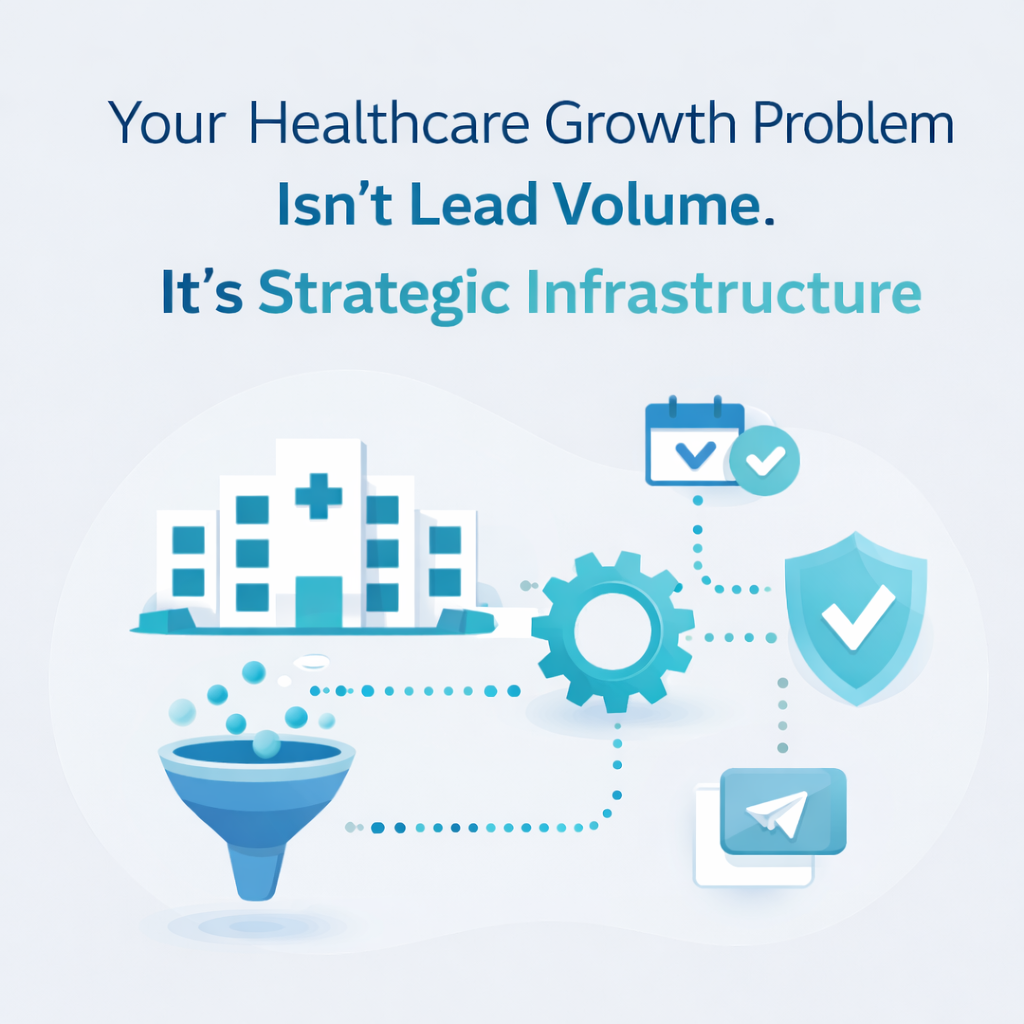
Your Healthcare Growth Problem Isn't Lead Volume. It's Strategic Infrastructure

Shan Serran
Shan Serran
January 27, 2026

You're generating leads. The phone rings. Forms get filled out. Your marketing dashboard shows activity.

But your census hasn't moved. Revenue stays flat. You're stuck watching inquiries evaporate somewhere between first contact and actual admissions.

The instinct is to generate more leads. Increase ad spend. Try another campaign. But here's what the data actually shows: only 1 in 9 inquiries convert to patients in medical practices, with average response times sitting at 47 hours.

More leads won't fix a 47-hour response gap.

The real problem isn't volume. It's the absence of strategic infrastructure that turns inquiries into outcomes. And in healthcare, where sales cycles stretch 12-24 months and involve 6-10 decision-makers, this gap becomes expensive fast.

The Strategic Deficit Most Healthcare Organizations Don't See

Healthcare operates under constraints most industries never face. Compliance requirements. Privacy regulations. Long decision cycles. Multiple stakeholders. Risk-averse buyers.

These aren't marketing problems. They're strategic realities that require systems designed specifically for how healthcare actually works.

But most healthcare organizations approach growth the same way B2C companies do: generate traffic, capture leads, hope something converts. That approach fails in healthcare because the fundamentals are different.

Consider what's actually happening:

Healthcare sales cycles require 12-24 months to close. Conversion rates from lead to opportunity sit at 15-25%—noticeably lower than the 30-40% in other industries. You're not just competing for attention. You're navigating regulatory complexity, building trust across multiple decision-makers, and proving value in an environment where mistakes carry serious consequences.

The organizations that grow aren't the ones generating the most leads. They're the ones who've built infrastructure that handles healthcare's unique friction points.

Why Lead Generation Becomes a Cost Center Without Strategic Foundation

Here's a number that should recalibrate how you think about marketing spend: 25% of ad clicks are fraudulent, with small medical practices wasting up to 30% of advertising budgets on fake traffic.

You're not just paying for leads that don't convert. You're paying for leads that were never real.

But even legitimate leads fail when your infrastructure can't handle them. A 47-hour response time in an industry where buyers are evaluating multiple options means you've already lost before you respond. Your competitor with a 2-hour response time wins—not because their marketing is better, but because their system is faster.

This is what strategic infrastructure looks like:

  • Response protocols that acknowledge healthcare decision timelines
  • Qualification frameworks that identify decision-makers early
  • Nurture systems designed for 12-24 month cycles
  • Compliance-aware communication that builds trust, not risk
  • Measurement focused on pipeline progression, not vanity metrics

Without these systems, lead generation becomes expensive noise. With them, every inquiry has a clear path to conversion.

The Hidden Cost of Interoperability and System Gaps

Interoperability failures cost the U.S. healthcare system $30 billion annually. That's not a marketing problem. That's a strategic infrastructure problem that marketing spend can't solve.

Healthcare organizations struggle with integration between existing systems like EHRs, creating friction at every stage of the patient or client journey. Your CRM doesn't talk to your scheduling system. Your intake process requires manual data entry. Your follow-up depends on someone remembering to send an email.

These gaps compound. A lead comes in, but no one knows who should respond. A prospect requests information, but the handoff between marketing and operations breaks down. A qualified inquiry sits in a queue because your system has no automation for the next step.

You can't market your way out of operational dysfunction.

The organizations that grow predictably have solved the infrastructure problem first. They've built systems that reduce friction, automate follow-up, and ensure every inquiry gets handled consistently—regardless of who's in the office that day.

What Strategic Infrastructure Actually Delivers

A regenerative medicine practice invested $27,000 in strategic infrastructure focused on lead qualification over volume. They achieved a 10% lead-to-patient conversion rate—compared to industry averages of 3-5%—and generated approximately $430,000 in revenue.

That's over 1,500% ROI. Not from more leads. From better systems.

Healthcare organizations that implemented consumer experience improvements saw revenue increase by up to 20% over five years while costs to serve decreased by up to 30%. The common factor wasn't budget expansion. It was strategic realignment of how they handled growth.

Here's what changes when you build strategic infrastructure:

Your response time drops from 47 hours to 2 hours because automation handles initial contact. Your qualification process identifies decision-makers early, so you're not wasting time on inquiries that will never close. Your nurture system keeps prospects engaged through 12-24 month cycles without manual effort.

You stop measuring success by lead volume and start measuring by pipeline progression. You know exactly where inquiries drop off and why. You can predict revenue based on inquiry flow because your conversion rates are consistent.

Growth becomes predictable. Not because you're spending more. Because your systems work.

The Shift From Tactical Spending to Strategic Investment

Healthcare marketing budgets shrank from 9.6% of total revenue in 2023 to 7.2% in 2024. But the organizations that grew didn't have bigger budgets. They had better infrastructure.

Audience targeting in healthcare typically delivers a 20-50% lift in conversion rates, with some healthcare marketers reporting up to 2x higher click-through rates. Yet nearly half of healthcare marketers have stopped targeting due to privacy laws—not because targeting doesn't work, but because they lack the strategic frameworks to implement it compliantly.

This is the gap.

Most healthcare organizations treat marketing as a tactical expense. Run ads. Generate leads. Hope for results. When growth stalls, they assume the problem is insufficient spend or the wrong channel.

But the organizations that grow consistently treat marketing as strategic infrastructure. They build systems designed for healthcare's unique constraints. They prioritize compliance-aware targeting. They measure what actually matters: qualified inquiries, admissions, census growth.

They don't chase volume. They build infrastructure that converts.

What You Need to Build Next

If your growth has plateaued, the problem isn't your marketing budget. It's the absence of strategic infrastructure that turns inquiries into outcomes.

Start here:

Audit your response time. If it's longer than 4 hours, you're losing qualified prospects to competitors with faster systems. Build automation that handles initial contact immediately, even if it's just acknowledgment and next steps.

Map your conversion funnel. Identify where inquiries drop off. Is it between first contact and follow-up? Between initial interest and decision-maker engagement? Between qualification and close? Your bottleneck tells you where to build infrastructure.

Measure what matters. Stop tracking impressions and clicks. Start tracking qualified inquiries, pipeline progression, and time-to-conversion. If you can't tie marketing activity to revenue outcomes, you're measuring the wrong things.

Build for compliance from the start. Privacy regulations aren't obstacles. They're forcing functions for better systems. Organizations that build compliance-aware infrastructure from day one avoid the costly retrofitting that stops growth later.

The shift isn't complicated. It's structural.

You need systems that handle healthcare's unique friction points. Response protocols designed for long sales cycles. Qualification frameworks that identify decision-makers early. Nurture systems that maintain engagement without manual effort.

Growth in healthcare doesn't come from generating more leads. It comes from building infrastructure that converts the inquiries you already have.

If you're ready to shift from tactical spending to strategic infrastructure, we should talk. Get a free consultation to see where your growth gaps are and what infrastructure you need to build next.

No pressure. Just clarity.

About the Author

Shan Serran

With experience of over 10 years in Digital Marketing, Shan has been helping businesses with SEO, SEM, and Social Media. He founded Veewz with the vision of providing transparency in the delivery of digital marketing services and better options for businesses of all sizes and domains. When he’s not working, Shan loves to spend time with his family, watch movies and support his favorite team the San Francisco Giants.

Related Article

Your Healthcare Growth Problem Isn't Lead Volume. It's Strategic Infrastructure

Shan Serran
January 27, 2026
|

You're generating leads. The phone rings. Forms get filled out. Your marketing dashboard shows activity.

But your census hasn't moved. Revenue stays flat. You're stuck watching inquiries evaporate somewhere between first contact and actual admissions.

The instinct is to generate more leads. Increase ad spend. Try another campaign. But here's what the data actually shows: only 1 in 9 inquiries convert to patients in medical practices, with average response times sitting at 47 hours.

More leads won't fix a 47-hour response gap.

The real problem isn't volume. It's the absence of strategic infrastructure that turns inquiries into outcomes. And in healthcare, where sales cycles stretch 12-24 months and involve 6-10 decision-makers, this gap becomes expensive fast.

The Strategic Deficit Most Healthcare Organizations Don't See

Healthcare operates under constraints most industries never face. Compliance requirements. Privacy regulations. Long decision cycles. Multiple stakeholders. Risk-averse buyers.

These aren't marketing problems. They're strategic realities that require systems designed specifically for how healthcare actually works.

But most healthcare organizations approach growth the same way B2C companies do: generate traffic, capture leads, hope something converts. That approach fails in healthcare because the fundamentals are different.

Consider what's actually happening:

Healthcare sales cycles require 12-24 months to close. Conversion rates from lead to opportunity sit at 15-25%—noticeably lower than the 30-40% in other industries. You're not just competing for attention. You're navigating regulatory complexity, building trust across multiple decision-makers, and proving value in an environment where mistakes carry serious consequences.

The organizations that grow aren't the ones generating the most leads. They're the ones who've built infrastructure that handles healthcare's unique friction points.

Why Lead Generation Becomes a Cost Center Without Strategic Foundation

Here's a number that should recalibrate how you think about marketing spend: 25% of ad clicks are fraudulent, with small medical practices wasting up to 30% of advertising budgets on fake traffic.

You're not just paying for leads that don't convert. You're paying for leads that were never real.

But even legitimate leads fail when your infrastructure can't handle them. A 47-hour response time in an industry where buyers are evaluating multiple options means you've already lost before you respond. Your competitor with a 2-hour response time wins—not because their marketing is better, but because their system is faster.

This is what strategic infrastructure looks like:

  • Response protocols that acknowledge healthcare decision timelines
  • Qualification frameworks that identify decision-makers early
  • Nurture systems designed for 12-24 month cycles
  • Compliance-aware communication that builds trust, not risk
  • Measurement focused on pipeline progression, not vanity metrics

Without these systems, lead generation becomes expensive noise. With them, every inquiry has a clear path to conversion.

The Hidden Cost of Interoperability and System Gaps

Interoperability failures cost the U.S. healthcare system $30 billion annually. That's not a marketing problem. That's a strategic infrastructure problem that marketing spend can't solve.

Healthcare organizations struggle with integration between existing systems like EHRs, creating friction at every stage of the patient or client journey. Your CRM doesn't talk to your scheduling system. Your intake process requires manual data entry. Your follow-up depends on someone remembering to send an email.

These gaps compound. A lead comes in, but no one knows who should respond. A prospect requests information, but the handoff between marketing and operations breaks down. A qualified inquiry sits in a queue because your system has no automation for the next step.

You can't market your way out of operational dysfunction.

The organizations that grow predictably have solved the infrastructure problem first. They've built systems that reduce friction, automate follow-up, and ensure every inquiry gets handled consistently—regardless of who's in the office that day.

What Strategic Infrastructure Actually Delivers

A regenerative medicine practice invested $27,000 in strategic infrastructure focused on lead qualification over volume. They achieved a 10% lead-to-patient conversion rate—compared to industry averages of 3-5%—and generated approximately $430,000 in revenue.

That's over 1,500% ROI. Not from more leads. From better systems.

Healthcare organizations that implemented consumer experience improvements saw revenue increase by up to 20% over five years while costs to serve decreased by up to 30%. The common factor wasn't budget expansion. It was strategic realignment of how they handled growth.

Here's what changes when you build strategic infrastructure:

Your response time drops from 47 hours to 2 hours because automation handles initial contact. Your qualification process identifies decision-makers early, so you're not wasting time on inquiries that will never close. Your nurture system keeps prospects engaged through 12-24 month cycles without manual effort.

You stop measuring success by lead volume and start measuring by pipeline progression. You know exactly where inquiries drop off and why. You can predict revenue based on inquiry flow because your conversion rates are consistent.

Growth becomes predictable. Not because you're spending more. Because your systems work.

The Shift From Tactical Spending to Strategic Investment

Healthcare marketing budgets shrank from 9.6% of total revenue in 2023 to 7.2% in 2024. But the organizations that grew didn't have bigger budgets. They had better infrastructure.

Audience targeting in healthcare typically delivers a 20-50% lift in conversion rates, with some healthcare marketers reporting up to 2x higher click-through rates. Yet nearly half of healthcare marketers have stopped targeting due to privacy laws—not because targeting doesn't work, but because they lack the strategic frameworks to implement it compliantly.

This is the gap.

Most healthcare organizations treat marketing as a tactical expense. Run ads. Generate leads. Hope for results. When growth stalls, they assume the problem is insufficient spend or the wrong channel.

But the organizations that grow consistently treat marketing as strategic infrastructure. They build systems designed for healthcare's unique constraints. They prioritize compliance-aware targeting. They measure what actually matters: qualified inquiries, admissions, census growth.

They don't chase volume. They build infrastructure that converts.

What You Need to Build Next

If your growth has plateaued, the problem isn't your marketing budget. It's the absence of strategic infrastructure that turns inquiries into outcomes.

Start here:

Audit your response time. If it's longer than 4 hours, you're losing qualified prospects to competitors with faster systems. Build automation that handles initial contact immediately, even if it's just acknowledgment and next steps.

Map your conversion funnel. Identify where inquiries drop off. Is it between first contact and follow-up? Between initial interest and decision-maker engagement? Between qualification and close? Your bottleneck tells you where to build infrastructure.

Measure what matters. Stop tracking impressions and clicks. Start tracking qualified inquiries, pipeline progression, and time-to-conversion. If you can't tie marketing activity to revenue outcomes, you're measuring the wrong things.

Build for compliance from the start. Privacy regulations aren't obstacles. They're forcing functions for better systems. Organizations that build compliance-aware infrastructure from day one avoid the costly retrofitting that stops growth later.

The shift isn't complicated. It's structural.

You need systems that handle healthcare's unique friction points. Response protocols designed for long sales cycles. Qualification frameworks that identify decision-makers early. Nurture systems that maintain engagement without manual effort.

Growth in healthcare doesn't come from generating more leads. It comes from building infrastructure that converts the inquiries you already have.

If you're ready to shift from tactical spending to strategic infrastructure, we should talk. Get a free consultation to see where your growth gaps are and what infrastructure you need to build next.

No pressure. Just clarity.

Author Bio

Shan Serran

With experience of over 10 years in Digital Marketing, Shan has been helping businesses with SEO, SEM, and Social Media. He founded Veewz with the vision of providing transparency in the delivery of digital marketing services and better options for businesses of all sizes and domains. When he’s not working, Shan loves to spend time with his family, watch movies and support his favorite team San Francisco Giants.

Do not sell my info