Blog / Article

Your SEO Strategy Is Missing Half The Picture

Shan Serran
Shan Serran
October 31, 2025

Google still dominates search volume. But your next customer might never see your site there.

We're entering a two-channel future. Traditional search engines on one side. Conversational AI platforms on the other.

The difference between them isn't just interface design. It's fundamental user behavior.

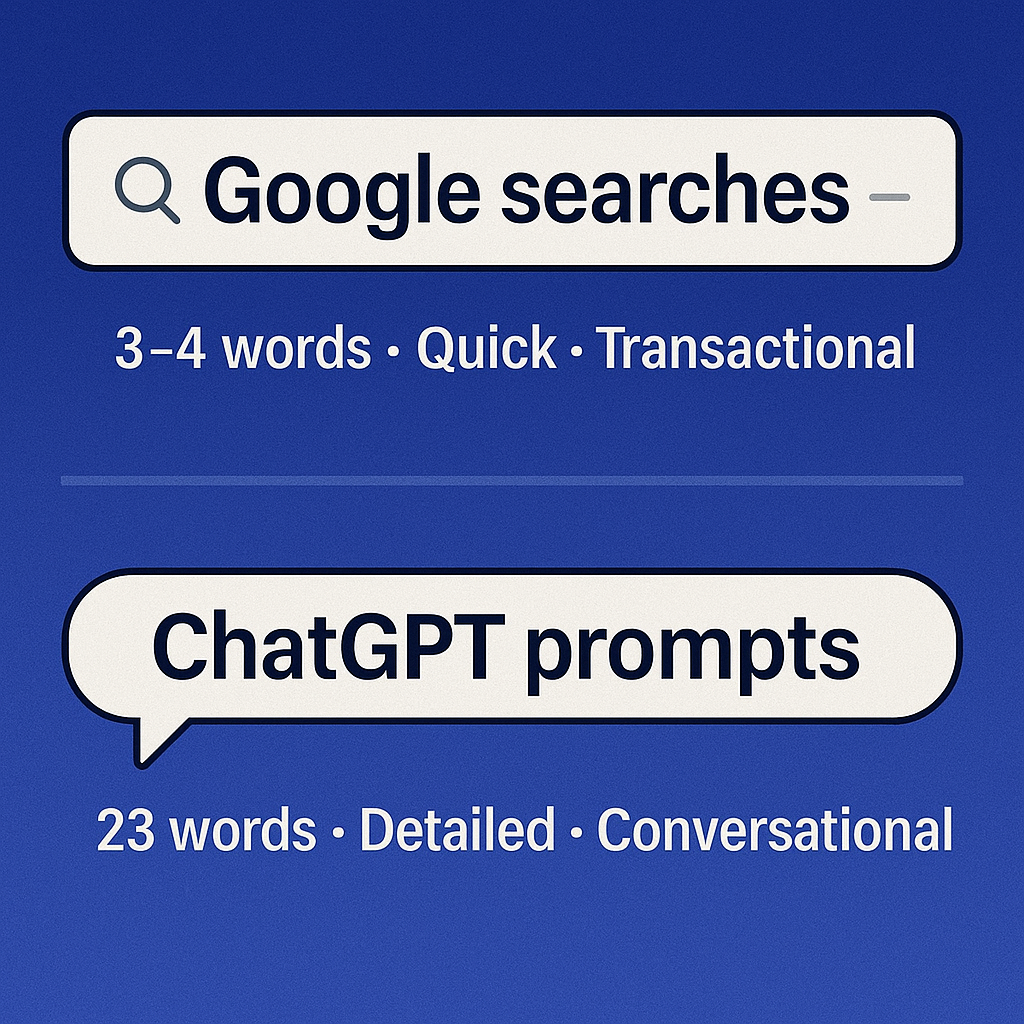
Google searches average 3-4 words. Quick. Transactional. "SaaS demand gen agency."

ChatGPT prompts average 23 words. Detailed. Conversational. "I'm launching a B2B SaaS product in healthcare and need help building a demand generation strategy that focuses on product-led growth and targets mid-market companies."

That's not just longer. It's a completely different intent signal.

And 70% of ChatGPT queries don't fit traditional search classifications. They're not navigational, informational, commercial, or transactional in the way we've understood search for two decades.
The Visibility Problem You're Not Solving

Here's what changed: In traditional search, you optimize for rankings. Position one, featured snippet, page one visibility.

In AI search, there are no rankings.

You're either cited in the response, or you don't exist.

Think about that for a second. All the SEO work you've done to climb from position seven to position three? Meaningless if an AI synthesizes an answer without mentioning you.

AI platforms already drive 6.5% of organic traffic, projected to hit 14.5% within the next year. That's not a trend to watch. That's traffic you're losing right now.

How AI Systems Actually Decide What To Cite

AI systems don't crawl and rank like Google. They learn patterns from massive datasets, then generate responses based on what they've absorbed.

Three factors determine whether you get cited: volume, consistency, and recency.

Volume means you can't publish five articles a quarter and expect visibility. AI systems learn from repeated exposure to your brand, your ideas, your frameworks.

Consistency means your message needs to appear across multiple formats and platforms. One blog post isn't enough. The same core idea needs to show up in video transcripts, social posts, podcast appearances, and visual content.

Recency is the killer most brands miss. Nearly 65% of AI bot hits target content published in the past year. That comprehensive guide you published in 2022? It's losing to mediocre content published last week.

The Content Repurposing Framework That Actually Works

You need modular content. One strong piece that fragments into multiple formats without losing coherence.

Start with a pillar article. Something substantial. 1,500-2,000 words addressing a specific problem your target customer faces.

Then break it apart:

Extract three key insights and turn each into a standalone social post. Not summaries. Actual valuable ideas that work independently.

Pull the most compelling data point and create a visual. Chart, infographic, or simple text-on-image. Something shareable that carries your brand.

Record a 3-5 minute video explaining the core framework. Upload it with a full transcript. AI systems crawl video transcripts.

Write a condensed version for LinkedIn or Medium. Same ideas, different structure, optimized for that platform's audience.

Take the most tactical section and expand it into a how-to guide or checklist. Make it downloadable.

You're not duplicating content. You're creating multiple entry points for the same strategic insight.

Each format reaches different audience segments. Each appearance trains AI systems that your brand owns this topic.

What Most SaaS Companies Get Wrong

They treat AI optimization like traditional SEO. They're chasing keywords and backlinks when they should be building semantic authority.

Semantic authority means AI systems recognize you as a credible source on specific topics. You earn it through consistent, high-quality content that demonstrates expertise.

You don't game it with keyword density or meta descriptions.

The other mistake? Waiting for perfect. AI systems reward momentum over polish. A good article published today beats a perfect article published next month.

Your content doesn't need to be flawless. It needs to be frequent, focused, and formatted for multiple channels.

The Practical Implementation Path

Start with one topic you want to own. Not "demand generation" broadly. Something specific. "Demand generation for healthcare SaaS companies targeting mid-market buyers."

Create one comprehensive piece on that topic. Include data, frameworks, and actionable steps.

Within 48 hours, repurpose that piece into at least three other formats. Video, visual, and condensed social version minimum.

Publish across your owned channels. Website, LinkedIn, YouTube, wherever your audience actually spends time.

Set a calendar reminder to update that content in 90 days. Fresh publication date, new data points, refined insights based on what you've learned.

Repeat this process every two weeks. That's 26 pillar pieces per year, each fragmented into multiple formats. You've just created 130+ content assets from 26 core ideas.

Why This Matters For Your Growth Strategy

Traditional SEO still works. Google still drives massive traffic. You shouldn't abandon what's working.

But if you're only optimizing for traditional search, you're building visibility in a shrinking channel.

The companies winning in the next three years will master both channels. They'll rank in Google and get cited by ChatGPT. They'll show up in search results and AI-generated answers.

That requires a different content strategy. More volume, more consistency, more formats, more freshness.

It's not about working harder. It's about working modularly. Creating content that fragments intelligently across channels while maintaining strategic coherence.

Your competitors are probably still focused on traditional SEO. That's your window.

Start building AI visibility now, while the competition is still figuring out what changed.

About the Author

Shan Serran

With experience of over 10 years in Digital Marketing, Shan has been helping businesses with SEO, SEM, and Social Media. He founded Veewz with the vision of providing transparency in the delivery of digital marketing services and better options for businesses of all sizes and domains. When he’s not working, Shan loves to spend time with his family, watch movies and support his favorite team the San Francisco Giants.

Related Article

Your SEO Strategy Is Missing Half The Picture

Shan Serran
October 31, 2025
|

Google still dominates search volume. But your next customer might never see your site there.

We're entering a two-channel future. Traditional search engines on one side. Conversational AI platforms on the other.

The difference between them isn't just interface design. It's fundamental user behavior.

Google searches average 3-4 words. Quick. Transactional. "SaaS demand gen agency."

ChatGPT prompts average 23 words. Detailed. Conversational. "I'm launching a B2B SaaS product in healthcare and need help building a demand generation strategy that focuses on product-led growth and targets mid-market companies."

That's not just longer. It's a completely different intent signal.

And 70% of ChatGPT queries don't fit traditional search classifications. They're not navigational, informational, commercial, or transactional in the way we've understood search for two decades.

The Visibility Problem You're Not Solving

Here's what changed: In traditional search, you optimize for rankings. Position one, featured snippet, page one visibility.

In AI search, there are no rankings.

You're either cited in the response, or you don't exist.

Think about that for a second. All the SEO work you've done to climb from position seven to position three? Meaningless if an AI synthesizes an answer without mentioning you.

AI platforms already drive 6.5% of organic traffic, projected to hit 14.5% within the next year. That's not a trend to watch. That's traffic you're losing right now.

How AI Systems Actually Decide What To Cite

AI systems don't crawl and rank like Google. They learn patterns from massive datasets, then generate responses based on what they've absorbed.

Three factors determine whether you get cited: volume, consistency, and recency.

Volume means you can't publish five articles a quarter and expect visibility. AI systems learn from repeated exposure to your brand, your ideas, your frameworks.

Consistency means your message needs to appear across multiple formats and platforms. One blog post isn't enough. The same core idea needs to show up in video transcripts, social posts, podcast appearances, and visual content.

Recency is the killer most brands miss. Nearly 65% of AI bot hits target content published in the past year. That comprehensive guide you published in 2022? It's losing to mediocre content published last week.

The Content Repurposing Framework That Actually Works

You need modular content. One strong piece that fragments into multiple formats without losing coherence.

Start with a pillar article. Something substantial. 1,500-2,000 words addressing a specific problem your target customer faces.

Then break it apart:

Extract three key insights and turn each into a standalone social post. Not summaries. Actual valuable ideas that work independently.

Pull the most compelling data point and create a visual. Chart, infographic, or simple text-on-image. Something shareable that carries your brand.

Record a 3-5 minute video explaining the core framework. Upload it with a full transcript. AI systems crawl video transcripts.

Write a condensed version for LinkedIn or Medium. Same ideas, different structure, optimized for that platform's audience.

Take the most tactical section and expand it into a how-to guide or checklist. Make it downloadable.

You're not duplicating content. You're creating multiple entry points for the same strategic insight.

Each format reaches different audience segments. Each appearance trains AI systems that your brand owns this topic.

What Most SaaS Companies Get Wrong

They treat AI optimization like traditional SEO. They're chasing keywords and backlinks when they should be building semantic authority.

Semantic authority means AI systems recognize you as a credible source on specific topics. You earn it through consistent, high-quality content that demonstrates expertise.

You don't game it with keyword density or meta descriptions.

The other mistake? Waiting for perfect. AI systems reward momentum over polish. A good article published today beats a perfect article published next month.

Your content doesn't need to be flawless. It needs to be frequent, focused, and formatted for multiple channels.

The Practical Implementation Path

Start with one topic you want to own. Not "demand generation" broadly. Something specific. "Demand generation for healthcare SaaS companies targeting mid-market buyers."

Create one comprehensive piece on that topic. Include data, frameworks, and actionable steps.

Within 48 hours, repurpose that piece into at least three other formats. Video, visual, and condensed social version minimum.

Publish across your owned channels. Website, LinkedIn, YouTube, wherever your audience actually spends time.

Set a calendar reminder to update that content in 90 days. Fresh publication date, new data points, refined insights based on what you've learned.

Repeat this process every two weeks. That's 26 pillar pieces per year, each fragmented into multiple formats. You've just created 130+ content assets from 26 core ideas.

Why This Matters For Your Growth Strategy

Traditional SEO still works. Google still drives massive traffic. You shouldn't abandon what's working.

But if you're only optimizing for traditional search, you're building visibility in a shrinking channel.

The companies winning in the next three years will master both channels. They'll rank in Google and get cited by ChatGPT. They'll show up in search results and AI-generated answers.

That requires a different content strategy. More volume, more consistency, more formats, more freshness.

It's not about working harder. It's about working modularly. Creating content that fragments intelligently across channels while maintaining strategic coherence.

Your competitors are probably still focused on traditional SEO. That's your window.

Start building AI visibility now, while the competition is still figuring out what changed.

Author Bio

Shan Serran

With experience of over 10 years in Digital Marketing, Shan has been helping businesses with SEO, SEM, and Social Media. He founded Veewz with the vision of providing transparency in the delivery of digital marketing services and better options for businesses of all sizes and domains. When he’s not working, Shan loves to spend time with his family, watch movies and support his favorite team San Francisco Giants.

Do not sell my info