
Blog / Article

How to Audit Your Healthcare Content Before Google's AI Updates Break Your Patient Acquisition

Shan Serran
Shan Serran
May 12, 2026

Google just announced five changes to how AI Overviews display links to external content. The company framed these updates as publisher-friendly adjustments designed to restore click-through rates.

I read the announcement. Then I looked at the data.

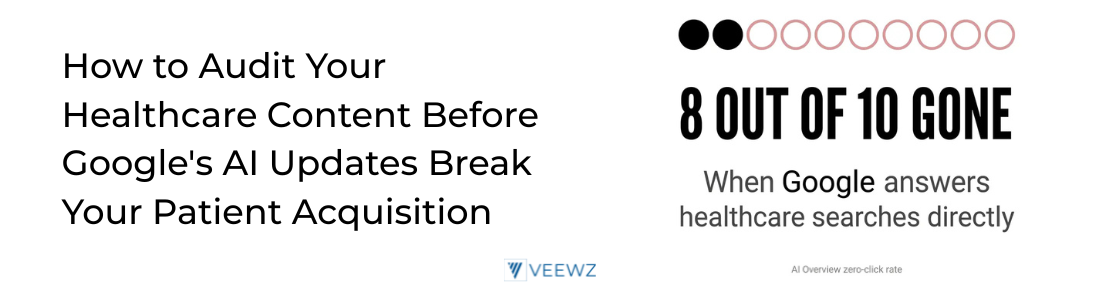
Healthcare searches now show an 83% zero-click rate when AI Overviews appear. That means 8 out of 10 people searching for healthcare information never click through to any website. Treatment and procedure queries show 100% AI Overview presence—up from 45% in 2023.

The updates Google announced won't fix this problem for most healthcare organizations. Here's what you need to check in your content systems right now, and what adjustments actually matter when AI answers replace clicks.

What Google Changed (and What It Actually Means for Healthcare)

Google's five updates focus on making links more visible within AI-generated answers. The changes include labeling content from paid subscriptions, adding a "Further Exploration" section with curated links, showing more inline citations, desktop preview pop-ups, and surfacing "Personal Perspectives" from social communities.

The subscription labeling matters if you run a paid healthcare publication. It doesn't help home health agencies, hospice providers, or senior care organizations.

The "Further Exploration" section pushes traditional organic results even further down the page. Early testing shows users click subscription-labeled links more often, but that benefit only applies to publishers with subscription models. For healthcare organizations without subscriptions, these updates offer no click-through improvement.

The core problem remains unchanged: when AI Overviews answer clinical questions directly, traffic to healthcare websites drops by 61%. Rankings hold steady while visitor counts collapse.

The Healthcare Traffic Collapse Nobody's Talking About

Major healthcare systems are already seeing the impact. Cleveland Clinic, Mayo Clinic, and Cedars-Sinai Medical Center have all experienced organic traffic declines exceeding 10% month-over-month. Some medical sites report 40-70% drops in traffic for informational content that AI Overviews directly answer.

Small publishers have lost 60% of referral traffic from Google over the past two years. When AI Overviews appear, just 8% of users click on traditional search results, compared to 15% when no overview appears.

Healthcare content is hit harder than any other sector. The queries that used to drive educational traffic—condition explanations, treatment options, care process overviews—now get answered without sending a single visitor to your site.

Here's what matters: the traffic you're losing probably wasn't driving patient inquiries anyway. But if you've been using educational content to build trust before conversion, that system just broke.

The One Search Category Google Hasn't Touched (Yet)

Local healthcare searches remain immune to AI disruption.

Queries like "ophthalmologist Nashville" or "home health agency near me" still show traditional search results with no AI summaries. Google has kept AI Overviews out of local provider searches entirely.

This means local SEO, Google Business Profile optimization, and location-based patient acquisition strategies still deliver results. The queries that drive new patient and client acquisition for small healthcare organizations remain unchanged.

If your marketing system depends on informational content to generate awareness, you have a problem. If your system focuses on local search visibility for high-intent queries, you're still in good shape.

What to Audit in Your Content System Right Now

Pull your Google Search Console data for the past 90 days. Look for pages that show steady or improving rankings but declining traffic. That's the AI Overview effect.

Check these specific elements:

Educational content that answers clinical questions. If you've published articles explaining conditions, treatments, or care processes, those pages are now competing with AI-generated summaries. Traffic will continue declining regardless of ranking position.

Service pages that explain what you do. If your service descriptions read like educational content rather than provider-specific positioning, AI Overviews may be answering the question before users reach your site. Reframe these pages around why someone should choose your organization, not just what the service involves.

Local search visibility for high-intent queries. Confirm your Google Business Profile is complete, accurate, and actively managed. Check that your NAP (name, address, phone) information is consistent across all directories. Verify that location-specific service pages target the right geographic terms.

Trust signals and differentiation. When educational content stops driving traffic, trust-building has to happen faster. Your site needs clear positioning, specific outcomes, and credible proof points visible within seconds of arrival.

Conversion paths from remaining traffic sources. If AI Overviews reduce top-of-funnel traffic by 60%, the visitors who do arrive need clearer paths to inquiry. Check your intake forms, contact options, and next-step clarity.

What Actually Works When AI Answers Replace Clicks

You can't outrank an AI Overview. You can't force Google to stop using your content to generate answers. The system changed, and complaining won't restore the traffic.

Here's what still produces patient and client inquiries:

Local search dominance. Own the map pack for your service area. Optimize for "near me" queries and location-specific terms. Keep your Google Business Profile active with posts, photos, and review responses. This is the search territory AI hasn't invaded yet.

Direct positioning over education. Stop writing content that answers general healthcare questions. Start writing content that explains why someone should choose your organization over alternatives. AI can summarize clinical information. It can't replicate your specific positioning, outcomes, or trust signals.

First-party traffic sources. Email lists, referral relationships, and direct traffic become more valuable when organic search declines. Build systems that don't depend on Google sending visitors.

Faster trust-building. When fewer people arrive through educational content, trust has to develop faster. Use specific outcomes, clear processes, and visible credibility markers. Generic "about us" content won't cut it.

Conversion-focused site structure. Every page should have a clear next step. If someone lands on your site, they need to know what to do within 10 seconds. Inquiry friction kills conversion when traffic volume drops.

The Compliance Trap in Google's New Features

Google's "Personal Perspectives" feature surfaces firsthand posts from social communities with creator attribution. The algorithm now gives weight to patient testimonials and community discussions.

Healthcare organizations face legal constraints on how they can use patient stories and testimonials. HIPAA limits what you can share. State regulations vary on testimonial usage. Asking patients to post reviews or experiences in specific ways can create compliance risk.

This creates an algorithmic advantage for content you can't legally control or encourage. Patient communities discussing their experiences may influence search visibility more than your own content—but you can't ethically coordinate that activity.

The practical response: focus on what you can control. Make it easy for satisfied patients to leave reviews naturally. Respond professionally to feedback. Build trust through transparency and outcomes, not by gaming social signals.

What This Means for Healthcare Organizations Without Subscriptions

Google's updates favor publishers with subscription models. If you run a healthcare publication with paid access, the new subscription labeling may help you retain clicks.

If you operate a home health agency, hospice provider, assisted living facility, or healthcare staffing company, these updates offer no benefit. You don't have subscriptions to label. The "Further Exploration" section just pushes your organic results further down the page.

The gap between large healthcare systems with content teams and small healthcare organizations with limited marketing resources is widening. AI Overviews hurt informational content across the board, but larger organizations have more resources to adapt.

Small healthcare organizations need to focus on what actually drives inquiries: local search visibility, clear positioning, trust-building at speed, and conversion-optimized site structure. Educational content strategies that worked in 2023 won't produce results in 2026.

The Immediate Action Plan

Stop publishing educational content that answers general healthcare questions. AI Overviews will summarize that information without sending traffic to your site.

Audit your Google Business Profile. Confirm every field is complete, accurate, and optimized for local search visibility. This is the search territory that still produces patient inquiries.

Review your service pages. Reframe content around provider-specific positioning rather than general service explanations. Make it clear why someone should choose your organization within the first paragraph.

Check your site's conversion paths. When traffic volume drops, conversion rate matters more. Remove friction from inquiry forms, contact options, and next-step clarity.

Build first-party traffic sources. Email lists, referral relationships, and direct traffic become more valuable when organic search declines. Reduce dependence on Google sending visitors.

Focus on trust signals that work at speed. Specific outcomes, clear processes, and visible credibility markers matter more when educational content stops driving awareness.

This isn't a temporary shift. AI-generated answers are now permanent fixtures in healthcare search results. The organizations that adapt their content systems to focus on local visibility, clear positioning, and fast trust-building will maintain inquiry flow. The ones waiting for Google to restore the old system will keep watching traffic decline while rankings hold steady.

The question isn't whether to adjust. It's whether you'll adjust before the traffic loss affects your census.

About the Author

Shan Serran

With experience of over 10 years in Digital Marketing, Shan has been helping businesses with SEO, SEM, and Social Media. He founded Veewz with the vision of providing transparency in the delivery of digital marketing services and better options for businesses of all sizes and domains. When he’s not working, Shan loves to spend time with his family, watch movies and support his favorite team the San Francisco Giants.

How to Audit Your Healthcare Content Before Google's AI Updates Break Your Patient Acquisition

Shan Serran
May 12, 2026
|

Google just announced five changes to how AI Overviews display links to external content. The company framed these updates as publisher-friendly adjustments designed to restore click-through rates.

I read the announcement. Then I looked at the data.

Healthcare searches now show an 83% zero-click rate when AI Overviews appear. That means 8 out of 10 people searching for healthcare information never click through to any website. Treatment and procedure queries show 100% AI Overview presence—up from 45% in 2023.

The updates Google announced won't fix this problem for most healthcare organizations. Here's what you need to check in your content systems right now, and what adjustments actually matter when AI answers replace clicks.

What Google Changed (and What It Actually Means for Healthcare)

Google's five updates focus on making links more visible within AI-generated answers. The changes include labeling content from paid subscriptions, adding a "Further Exploration" section with curated links, showing more inline citations, desktop preview pop-ups, and surfacing "Personal Perspectives" from social communities.

The subscription labeling matters if you run a paid healthcare publication. It doesn't help home health agencies, hospice providers, or senior care organizations.

The "Further Exploration" section pushes traditional organic results even further down the page. Early testing shows users click subscription-labeled links more often, but that benefit only applies to publishers with subscription models. For healthcare organizations without subscriptions, these updates offer no click-through improvement.

The core problem remains unchanged: when AI Overviews answer clinical questions directly, traffic to healthcare websites drops by 61%. Rankings hold steady while visitor counts collapse.

The Healthcare Traffic Collapse Nobody's Talking About

Major healthcare systems are already seeing the impact. Cleveland Clinic, Mayo Clinic, and Cedars-Sinai Medical Center have all experienced organic traffic declines exceeding 10% month-over-month. Some medical sites report 40-70% drops in traffic for informational content that AI Overviews directly answer.

Small publishers have lost 60% of referral traffic from Google over the past two years. When AI Overviews appear, just 8% of users click on traditional search results, compared to 15% when no overview appears.

Healthcare content is hit harder than any other sector. The queries that used to drive educational traffic—condition explanations, treatment options, care process overviews—now get answered without sending a single visitor to your site.

Here's what matters: the traffic you're losing probably wasn't driving patient inquiries anyway. But if you've been using educational content to build trust before conversion, that system just broke.

The One Search Category Google Hasn't Touched (Yet)

Local healthcare searches remain immune to AI disruption.

Queries like "ophthalmologist Nashville" or "home health agency near me" still show traditional search results with no AI summaries. Google has kept AI Overviews out of local provider searches entirely.

This means local SEO, Google Business Profile optimization, and location-based patient acquisition strategies still deliver results. The queries that drive new patient and client acquisition for small healthcare organizations remain unchanged.

If your marketing system depends on informational content to generate awareness, you have a problem. If your system focuses on local search visibility for high-intent queries, you're still in good shape.

What to Audit in Your Content System Right Now

Pull your Google Search Console data for the past 90 days. Look for pages that show steady or improving rankings but declining traffic. That's the AI Overview effect.

Check these specific elements:

Educational content that answers clinical questions. If you've published articles explaining conditions, treatments, or care processes, those pages are now competing with AI-generated summaries. Traffic will continue declining regardless of ranking position.

Service pages that explain what you do. If your service descriptions read like educational content rather than provider-specific positioning, AI Overviews may be answering the question before users reach your site. Reframe these pages around why someone should choose your organization, not just what the service involves.

Local search visibility for high-intent queries. Confirm your Google Business Profile is complete, accurate, and actively managed. Check that your NAP (name, address, phone) information is consistent across all directories. Verify that location-specific service pages target the right geographic terms.

Trust signals and differentiation. When educational content stops driving traffic, trust-building has to happen faster. Your site needs clear positioning, specific outcomes, and credible proof points visible within seconds of arrival.

Conversion paths from remaining traffic sources. If AI Overviews reduce top-of-funnel traffic by 60%, the visitors who do arrive need clearer paths to inquiry. Check your intake forms, contact options, and next-step clarity.

What Actually Works When AI Answers Replace Clicks

You can't outrank an AI Overview. You can't force Google to stop using your content to generate answers. The system changed, and complaining won't restore the traffic.

Here's what still produces patient and client inquiries:

Local search dominance. Own the map pack for your service area. Optimize for "near me" queries and location-specific terms. Keep your Google Business Profile active with posts, photos, and review responses. This is the search territory AI hasn't invaded yet.

Direct positioning over education. Stop writing content that answers general healthcare questions. Start writing content that explains why someone should choose your organization over alternatives. AI can summarize clinical information. It can't replicate your specific positioning, outcomes, or trust signals.

First-party traffic sources. Email lists, referral relationships, and direct traffic become more valuable when organic search declines. Build systems that don't depend on Google sending visitors.

Faster trust-building. When fewer people arrive through educational content, trust has to develop faster. Use specific outcomes, clear processes, and visible credibility markers. Generic "about us" content won't cut it.

Conversion-focused site structure. Every page should have a clear next step. If someone lands on your site, they need to know what to do within 10 seconds. Inquiry friction kills conversion when traffic volume drops.

The Compliance Trap in Google's New Features

Google's "Personal Perspectives" feature surfaces firsthand posts from social communities with creator attribution. The algorithm now gives weight to patient testimonials and community discussions.

Healthcare organizations face legal constraints on how they can use patient stories and testimonials. HIPAA limits what you can share. State regulations vary on testimonial usage. Asking patients to post reviews or experiences in specific ways can create compliance risk.

This creates an algorithmic advantage for content you can't legally control or encourage. Patient communities discussing their experiences may influence search visibility more than your own content—but you can't ethically coordinate that activity.

The practical response: focus on what you can control. Make it easy for satisfied patients to leave reviews naturally. Respond professionally to feedback. Build trust through transparency and outcomes, not by gaming social signals.

What This Means for Healthcare Organizations Without Subscriptions

Google's updates favor publishers with subscription models. If you run a healthcare publication with paid access, the new subscription labeling may help you retain clicks.

If you operate a home health agency, hospice provider, assisted living facility, or healthcare staffing company, these updates offer no benefit. You don't have subscriptions to label. The "Further Exploration" section just pushes your organic results further down the page.

The gap between large healthcare systems with content teams and small healthcare organizations with limited marketing resources is widening. AI Overviews hurt informational content across the board, but larger organizations have more resources to adapt.

Small healthcare organizations need to focus on what actually drives inquiries: local search visibility, clear positioning, trust-building at speed, and conversion-optimized site structure. Educational content strategies that worked in 2023 won't produce results in 2026.

The Immediate Action Plan

Stop publishing educational content that answers general healthcare questions. AI Overviews will summarize that information without sending traffic to your site.

Audit your Google Business Profile. Confirm every field is complete, accurate, and optimized for local search visibility. This is the search territory that still produces patient inquiries.

Review your service pages. Reframe content around provider-specific positioning rather than general service explanations. Make it clear why someone should choose your organization within the first paragraph.

Check your site's conversion paths. When traffic volume drops, conversion rate matters more. Remove friction from inquiry forms, contact options, and next-step clarity.

Build first-party traffic sources. Email lists, referral relationships, and direct traffic become more valuable when organic search declines. Reduce dependence on Google sending visitors.

Focus on trust signals that work at speed. Specific outcomes, clear processes, and visible credibility markers matter more when educational content stops driving awareness.

This isn't a temporary shift. AI-generated answers are now permanent fixtures in healthcare search results. The organizations that adapt their content systems to focus on local visibility, clear positioning, and fast trust-building will maintain inquiry flow. The ones waiting for Google to restore the old system will keep watching traffic decline while rankings hold steady.

The question isn't whether to adjust. It's whether you'll adjust before the traffic loss affects your census.

Author Bio

Shan Serran

With experience of over 10 years in Digital Marketing, Shan has been helping businesses with SEO, SEM, and Social Media. He founded Veewz with the vision of providing transparency in the delivery of digital marketing services and better options for businesses of all sizes and domains. When he’s not working, Shan loves to spend time with his family, watch movies and support his favorite team San Francisco Giants.

Do not sell my info