
Blog / Article

The Intake Paradox: Why Lead Volume is the Silent Killer of Medical Franchise Scaling

You just spent $15,000 on a marketing campaign that generated 200 leads.

Your intake team can handle 40 calls per week. You just bought 200 problems.

This is the intake paradox: the more leads you generate without system capacity, the more damage you do to your brand. In healthcare, a lead isn't an opportunity until your system can convert it. Before that moment, it's a liability.

Most medical franchises treat lead volume as the primary success metric. More traffic, more form fills, more calls. The assumption is simple: more leads equal more patients.

That assumption is killing your ROI.

The 2-Hour Death Zone

Healthcare has the slowest average lead response time across all industries: 2 hours and 5 minutes.

That number should alarm you.

Research shows that leads contacted within 5 minutes are 21 times more likely to qualify compared to those contacted after 30 minutes. After just one hour, more than 50% of leads have already engaged with a competitor.

When someone searches for "urgent care near me" or "physical therapy for back pain," they're not browsing. They're in pain. They need help now.

A 2-hour response time doesn't just lose the lead. It signals operational incompetence.

The prospective patient draws a direct line: if you can't return a phone call promptly, how will you handle their care? In regulated healthcare environments, trust decays exponentially with every minute of silence.

You're not competing on clinical quality at this stage. You're competing on operational reliability.

Volume vs. Velocity: The Wrong Metric

Lead volume is the lazy marketer's metric.

It's easy to measure, easy to report, and easy to celebrate. But in healthcare, volume without velocity creates a bottleneck that damages everything downstream.

Consider the math:

Scenario A: You generate 100 leads. Your team responds within 5 minutes to 30% of them. Your conversion rate on those fast responses is 15%. You acquire 4-5 patients.

Scenario B: You generate 40 leads. Your team responds within 5 minutes to 90% of them. Your conversion rate is 25%. You acquire 9 patients.

Same marketing budget. Fewer leads. Better outcomes.

The difference is friction.

High-friction, high-intent qualification filters for patients your system can actually serve. When you increase front-end friction through stricter qualification, deeper intake forms, and more deliberate lead scoring, you reduce volume but improve velocity.

Medical practices implementing lead scoring and qualification systems improve conversion rates by 40-60% while reducing marketing waste. One regenerative medicine practice achieved a 10% lead-to-patient conversion rate—more than double the industry average—by focusing on qualification instead of volume.

The result: $430,000 in revenue from a $27,000 investment. Over 1,500% ROI.

That's not a marketing win. That's a systems win.

The Trust Decay Problem

Public confidence in healthcare providers has collapsed.

Between April 2020 and January 2024, trust in physicians and hospitals dropped from 71.5% to 40.1%. When 68% of patients believe provider organizations put their own interests ahead of patients, every operational failure becomes proof of incompetence.

Slow response times aren't just inconvenient. They're evidence.

When a prospective patient fills out a form at 2 PM and doesn't hear back until the next morning, they don't think, "They must be busy." They think, "They don't care."

You can't market your way out of operational dysfunction.

If your intake process creates friction, delays, or confusion, your marketing is actively damaging your brand. You're paying to generate negative experiences.

This is why lead volume without system capacity is dangerous. Every unanswered call, every delayed callback, every confused voicemail—these aren't just lost opportunities. They're trust signals pointing the wrong direction.

SEO as Trust Infrastructure, Not Lead Generation

Most medical franchises treat SEO as a lead-generation tool.

They optimize for keywords like "best physical therapy near me" or "top-rated urgent care" and measure success by organic traffic and form fills.

That's backwards.

In regulated environments, you don't buy attention. You earn trust through systems.

SEO in healthcare should function as trust infrastructure. Your digital footprint needs to pass a compliance audit while simultaneously reducing patient anxiety. That means:

• Clear, accurate service descriptions that match operational capacity
• Transparent pricing and insurance information where appropriate
• Accessible contact methods with realistic response time expectations
• Compliance-aware content that builds credibility without making unverifiable claims
• Reviews and testimonials that reflect actual patient experiences

When you architect your digital presence this way, SEO becomes a filtering mechanism. The patients who find you are already pre-qualified by the clarity and specificity of your content.

This is why recent system audits reveal that medical franchises treating SEO as a trust-building mechanism outperform those chasing traffic volume on patient acquisition cost metrics. The leads are fewer, but the conversion rates are 2-10x higher.

You're not optimizing for volume. You're optimizing for alignment between what you promise and what you can deliver.

The Operator Manifesto: System-First Growth

If you don't understand the intake bottleneck, you aren't marketing. You're subsidizing Google's balance sheet.

The Systems Operator view is simple: marketing without operational capacity is liability, not growth.

Here's what that looks like in practice:

Audit your current intake capacity. How many leads can your team realistically handle per week? What's your average response time? What percentage of qualified calls convert to scheduled appointments?

Calculate your true patient acquisition cost. Most practices underestimate acquisition costs by 40-60% because they ignore staff time for lead qualification, no-show appointments, and system overhead. Cheap leads often cost more when you factor in the operational burden.

Design friction into your lead generation. Use intake forms that require more information upfront. Ask qualifying questions that filter out low-intent inquiries. Make it slightly harder to become a lead—and dramatically easier to become a patient once someone qualifies.

Build response velocity into your operations. Seventy-seven percent of health system leaders cite capacity constraints as their most significant operational challenge. But capacity isn't just about bed availability or provider schedules. It's about intake speed, follow-up consistency, and communication clarity.

Measure conversion, not volume. The average healthcare conversion rate is 3.2%. Top performers achieve 21%. That gap isn't about marketing tactics. It's about system design.

When you shift from volume-first to system-first thinking, your marketing becomes predictable. You know how many leads you need because you know your conversion rate. You know your conversion rate because you've built systems that support it.

The Hidden Cost of "Cheap" Leads

Healthcare cost-per-lead ranges from $26 to $50 depending on specialty and geography.

That number is meaningless without context.

A $30 lead that takes 3 hours of staff time to qualify, results in a no-show appointment, and requires two follow-up calls isn't cheap. It's expensive.

A $75 lead that converts in one call, shows up for the appointment, and becomes a long-term patient is a bargain.

Patient acquisition cost tells the real story. Most practices focus on the front-end metric (CPL) and ignore the back-end reality (CAC). The difference between the two is where your operational dysfunction lives.

When 25% of calls go unanswered and 59% of qualified callers never book appointments, you're not dealing with a marketing problem. You're dealing with a systems problem that marketing is exposing.

Medical practices lose up to 90% of potential patients through inefficient lead management. That's not a conversion issue. That's a design failure.

article cover

Capacity Constraints Are the New Growth Ceiling

Ninety-one percent of health systems report they can't accommodate patients in a timely manner.

By 2034, annual inpatient days are projected to reach 170 million—a 9% increase from current levels. Meanwhile, 77% of health system leaders cite emergency department holds as their most significant bottleneck.

Marketing that ignores operational capacity doesn't just waste money. It damages the brand.

When you generate more demand than your system can handle, you create negative experiences at scale. Every delayed callback, every scheduling conflict, every "we're not accepting new patients right now" message—these aren't operational hiccups. They're brand liabilities.

The solution isn't to stop marketing. The solution is to build marketing systems that respect operational reality.

That means:

• Aligning lead volume with intake capacity
• Building qualification friction into the front end
• Designing response protocols that prioritize speed
• Creating trust signals that reduce patient anxiety
• Measuring conversion rates, not just lead counts

When you treat marketing as a system that feeds into operations—not a separate function that generates volume—you create sustainable growth.

What This Means for Your Franchise

If you're celebrating a 50% increase in lead volume, ask yourself: can your system handle it?

If your answer is "we'll figure it out," you're already behind.

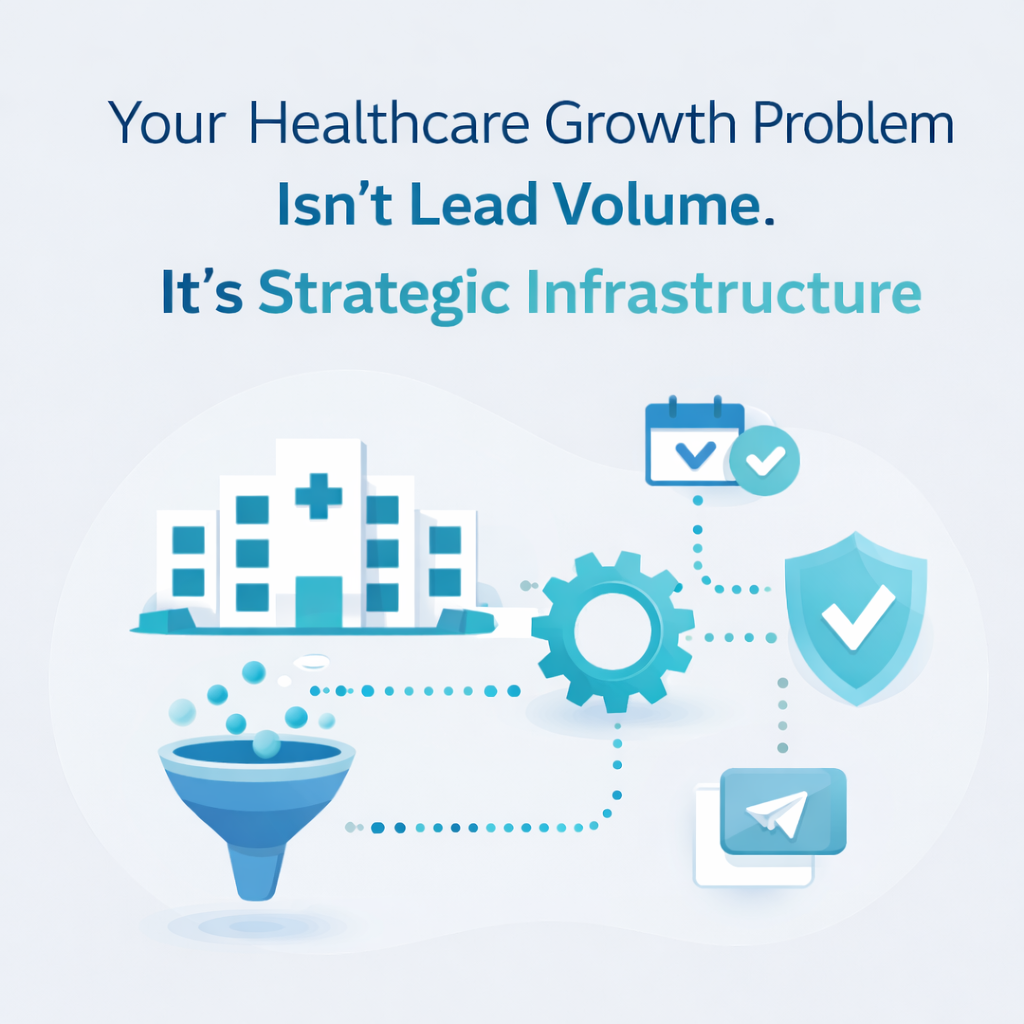
Growth in healthcare requires infrastructure. You can't scale patient acquisition without scaling intake capacity, response velocity, and operational clarity.

The medical franchises that win over the next decade won't be the ones with the biggest marketing budgets. They'll be the ones with the tightest systems.

They'll understand that in regulated environments, trust is the constraint. And trust doesn't come from visibility. It comes from reliability.

You don't market your way to growth. You build systems that earn it.

If your current approach prioritizes lead volume over system capacity, you're not scaling. You're creating a bottleneck that will eventually break your brand.

The question isn't whether you need more leads. The question is whether your system can handle the leads you already have.

If the answer is no, more marketing is the last thing you need.

About the Author

The Intake Paradox: Why Lead Volume is the Silent Killer of Medical Franchise Scaling

|

You just spent $15,000 on a marketing campaign that generated 200 leads.

Your intake team can handle 40 calls per week. You just bought 200 problems.

This is the intake paradox: the more leads you generate without system capacity, the more damage you do to your brand. In healthcare, a lead isn't an opportunity until your system can convert it. Before that moment, it's a liability.

Most medical franchises treat lead volume as the primary success metric. More traffic, more form fills, more calls. The assumption is simple: more leads equal more patients.

That assumption is killing your ROI.

The 2-Hour Death Zone

Healthcare has the slowest average lead response time across all industries: 2 hours and 5 minutes.

That number should alarm you.

Research shows that leads contacted within 5 minutes are 21 times more likely to qualify compared to those contacted after 30 minutes. After just one hour, more than 50% of leads have already engaged with a competitor.

When someone searches for "urgent care near me" or "physical therapy for back pain," they're not browsing. They're in pain. They need help now.

A 2-hour response time doesn't just lose the lead. It signals operational incompetence.

The prospective patient draws a direct line: if you can't return a phone call promptly, how will you handle their care? In regulated healthcare environments, trust decays exponentially with every minute of silence.

You're not competing on clinical quality at this stage. You're competing on operational reliability.

Volume vs. Velocity: The Wrong Metric

Lead volume is the lazy marketer's metric.

It's easy to measure, easy to report, and easy to celebrate. But in healthcare, volume without velocity creates a bottleneck that damages everything downstream.

Consider the math:

Scenario A: You generate 100 leads. Your team responds within 5 minutes to 30% of them. Your conversion rate on those fast responses is 15%. You acquire 4-5 patients.

Scenario B: You generate 40 leads. Your team responds within 5 minutes to 90% of them. Your conversion rate is 25%. You acquire 9 patients.

Same marketing budget. Fewer leads. Better outcomes.

The difference is friction.

High-friction, high-intent qualification filters for patients your system can actually serve. When you increase front-end friction through stricter qualification, deeper intake forms, and more deliberate lead scoring, you reduce volume but improve velocity.

Medical practices implementing lead scoring and qualification systems improve conversion rates by 40-60% while reducing marketing waste. One regenerative medicine practice achieved a 10% lead-to-patient conversion rate—more than double the industry average—by focusing on qualification instead of volume.

The result: $430,000 in revenue from a $27,000 investment. Over 1,500% ROI.

That's not a marketing win. That's a systems win.

The Trust Decay Problem

Public confidence in healthcare providers has collapsed.

Between April 2020 and January 2024, trust in physicians and hospitals dropped from 71.5% to 40.1%. When 68% of patients believe provider organizations put their own interests ahead of patients, every operational failure becomes proof of incompetence.

Slow response times aren't just inconvenient. They're evidence.

When a prospective patient fills out a form at 2 PM and doesn't hear back until the next morning, they don't think, "They must be busy." They think, "They don't care."

You can't market your way out of operational dysfunction.

If your intake process creates friction, delays, or confusion, your marketing is actively damaging your brand. You're paying to generate negative experiences.

This is why lead volume without system capacity is dangerous. Every unanswered call, every delayed callback, every confused voicemail—these aren't just lost opportunities. They're trust signals pointing the wrong direction.

SEO as Trust Infrastructure, Not Lead Generation

Most medical franchises treat SEO as a lead-generation tool.

They optimize for keywords like "best physical therapy near me" or "top-rated urgent care" and measure success by organic traffic and form fills.

That's backwards.

In regulated environments, you don't buy attention. You earn trust through systems.

SEO in healthcare should function as trust infrastructure. Your digital footprint needs to pass a compliance audit while simultaneously reducing patient anxiety. That means:

• Clear, accurate service descriptions that match operational capacity
• Transparent pricing and insurance information where appropriate
• Accessible contact methods with realistic response time expectations
• Compliance-aware content that builds credibility without making unverifiable claims
• Reviews and testimonials that reflect actual patient experiences

When you architect your digital presence this way, SEO becomes a filtering mechanism. The patients who find you are already pre-qualified by the clarity and specificity of your content.

This is why recent system audits reveal that medical franchises treating SEO as a trust-building mechanism outperform those chasing traffic volume on patient acquisition cost metrics. The leads are fewer, but the conversion rates are 2-10x higher.

You're not optimizing for volume. You're optimizing for alignment between what you promise and what you can deliver.

The Operator Manifesto: System-First Growth

If you don't understand the intake bottleneck, you aren't marketing. You're subsidizing Google's balance sheet.

The Systems Operator view is simple: marketing without operational capacity is liability, not growth.

Here's what that looks like in practice:

Audit your current intake capacity. How many leads can your team realistically handle per week? What's your average response time? What percentage of qualified calls convert to scheduled appointments?

Calculate your true patient acquisition cost. Most practices underestimate acquisition costs by 40-60% because they ignore staff time for lead qualification, no-show appointments, and system overhead. Cheap leads often cost more when you factor in the operational burden.

Design friction into your lead generation. Use intake forms that require more information upfront. Ask qualifying questions that filter out low-intent inquiries. Make it slightly harder to become a lead—and dramatically easier to become a patient once someone qualifies.

Build response velocity into your operations. Seventy-seven percent of health system leaders cite capacity constraints as their most significant operational challenge. But capacity isn't just about bed availability or provider schedules. It's about intake speed, follow-up consistency, and communication clarity.

Measure conversion, not volume. The average healthcare conversion rate is 3.2%. Top performers achieve 21%. That gap isn't about marketing tactics. It's about system design.

When you shift from volume-first to system-first thinking, your marketing becomes predictable. You know how many leads you need because you know your conversion rate. You know your conversion rate because you've built systems that support it.

The Hidden Cost of "Cheap" Leads

Healthcare cost-per-lead ranges from $26 to $50 depending on specialty and geography.

That number is meaningless without context.

A $30 lead that takes 3 hours of staff time to qualify, results in a no-show appointment, and requires two follow-up calls isn't cheap. It's expensive.

A $75 lead that converts in one call, shows up for the appointment, and becomes a long-term patient is a bargain.

Patient acquisition cost tells the real story. Most practices focus on the front-end metric (CPL) and ignore the back-end reality (CAC). The difference between the two is where your operational dysfunction lives.

When 25% of calls go unanswered and 59% of qualified callers never book appointments, you're not dealing with a marketing problem. You're dealing with a systems problem that marketing is exposing.

Medical practices lose up to 90% of potential patients through inefficient lead management. That's not a conversion issue. That's a design failure.

article cover

Capacity Constraints Are the New Growth Ceiling

Ninety-one percent of health systems report they can't accommodate patients in a timely manner.

By 2034, annual inpatient days are projected to reach 170 million—a 9% increase from current levels. Meanwhile, 77% of health system leaders cite emergency department holds as their most significant bottleneck.

Marketing that ignores operational capacity doesn't just waste money. It damages the brand.

When you generate more demand than your system can handle, you create negative experiences at scale. Every delayed callback, every scheduling conflict, every "we're not accepting new patients right now" message—these aren't operational hiccups. They're brand liabilities.

The solution isn't to stop marketing. The solution is to build marketing systems that respect operational reality.

That means:

• Aligning lead volume with intake capacity
• Building qualification friction into the front end
• Designing response protocols that prioritize speed
• Creating trust signals that reduce patient anxiety
• Measuring conversion rates, not just lead counts

When you treat marketing as a system that feeds into operations—not a separate function that generates volume—you create sustainable growth.

What This Means for Your Franchise

If you're celebrating a 50% increase in lead volume, ask yourself: can your system handle it?

If your answer is "we'll figure it out," you're already behind.

Growth in healthcare requires infrastructure. You can't scale patient acquisition without scaling intake capacity, response velocity, and operational clarity.

The medical franchises that win over the next decade won't be the ones with the biggest marketing budgets. They'll be the ones with the tightest systems.

They'll understand that in regulated environments, trust is the constraint. And trust doesn't come from visibility. It comes from reliability.

You don't market your way to growth. You build systems that earn it.

If your current approach prioritizes lead volume over system capacity, you're not scaling. You're creating a bottleneck that will eventually break your brand.

The question isn't whether you need more leads. The question is whether your system can handle the leads you already have.

If the answer is no, more marketing is the last thing you need.

Author Bio

With experience of over 10 years in Digital Marketing, Shan has been helping businesses with SEO, SEM, and Social Media. He founded Veewz with the vision of providing transparency in the delivery of digital marketing services and better options for businesses of all sizes and domains. When he’s not working, Shan loves to spend time with his family, watch movies and support his favorite team San Francisco Giants.

Do not sell my info